CNCF 10 Years: CPU Native vs GPU NativeCNCF 十周年:CPU 原生 vs GPU 原生

MAKE CLOUD NATIVE UBIQUITOUS让云原生无处不在(MAKE CLOUD NATIVE UBIQUITOUS)
Appointed CNCF Ambassador: 2025 – 2027, issued by The Linux Foundation.获任 CNCF Ambassador:2025 – 2027,由 The Linux Foundation 颁发。
CNCF (Cloud Native Computing Foundation) turns 10. I published a post when Kubernetes turns 10 in 2024. It's the same sentiment. It’s been a magic journey to be part of these programs for half of their ten-year history. I am honored and humbled for the opportunity to help various roles, such as Local Community Lead, Ambassador, Program Committee Member, and Speaker.
Motivated by Janet Kuo's presentation, 'Kubernetes at 10: A Decade of Community-Powered Innovation,' from the KuberTENes Birthday Bash at Google Mountain View Bay View office, along with the event’s T-shirt design. List my ten KubeCon:
Naming as CNCF Ambassador
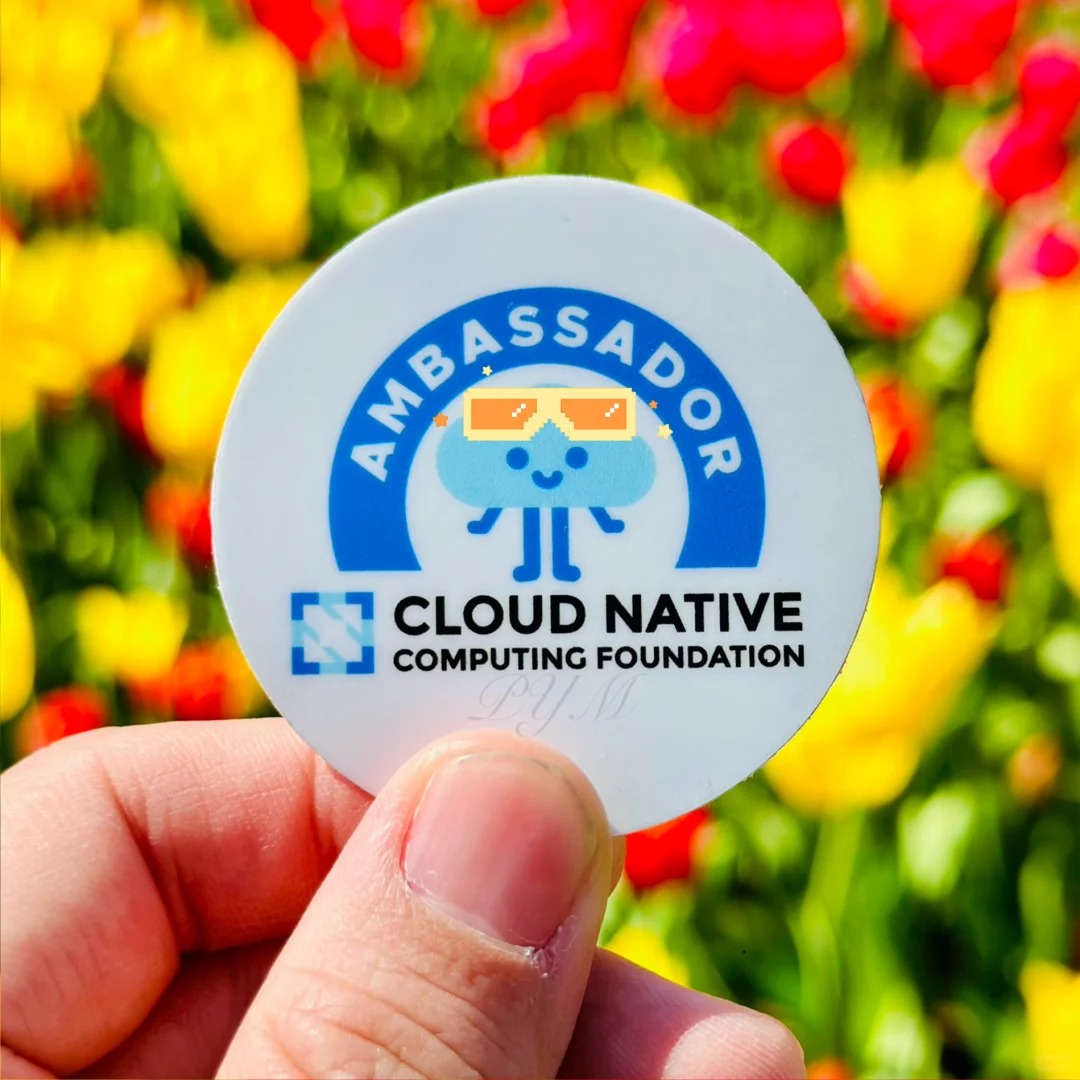
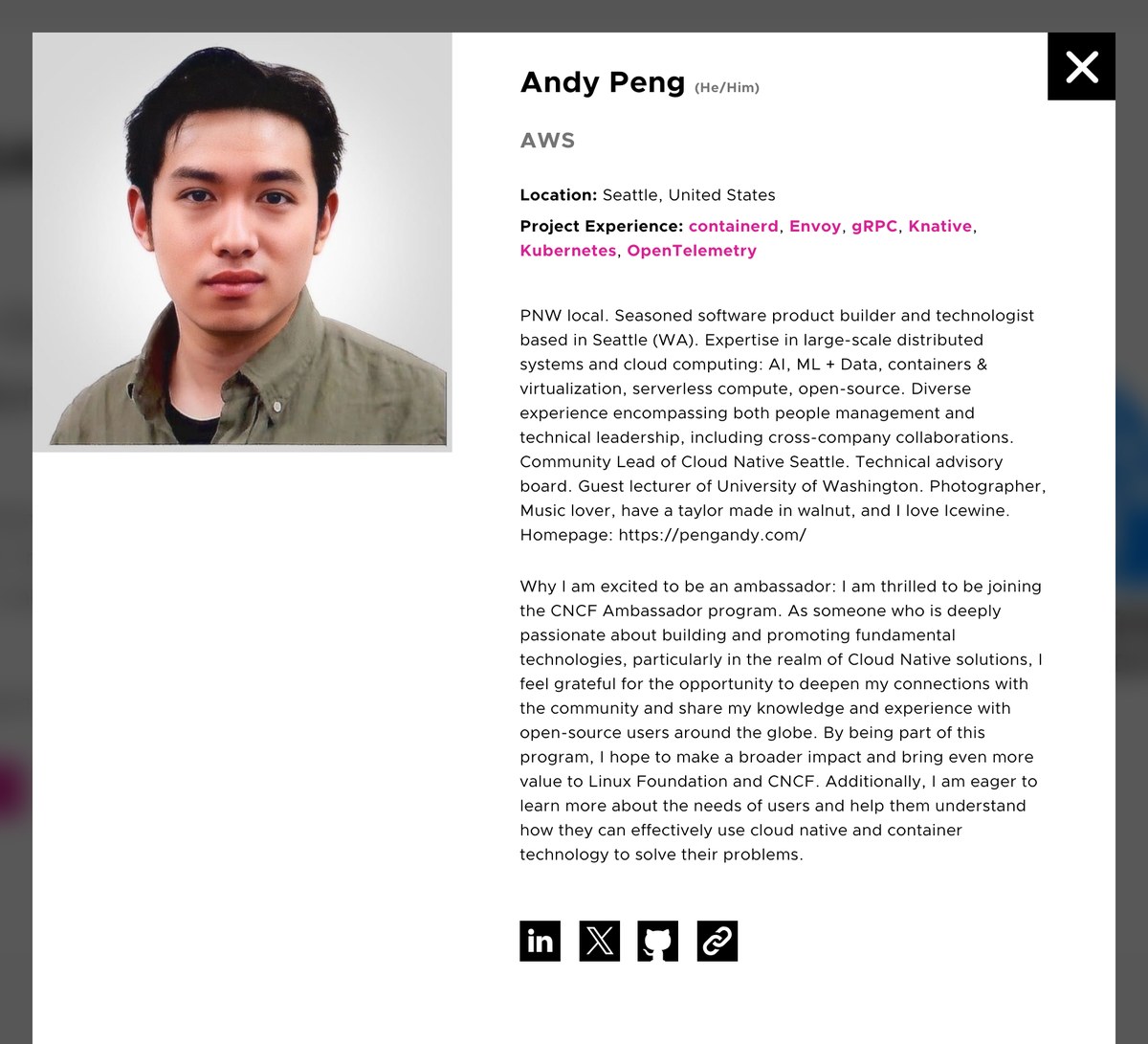
I was first named a CNCF Ambassador in late 2022, with the announcement made public during KubeCon Europe 2023 in Amsterdam. I remember at the time, only three Ambassadors were selected from Amazon, one of them was my mentor and colleague, a Principal Engineer in the same VP organization. And I was the only one based in Seattle. After completing my one-year term, I’ve been reappointed as a CNCF Ambassador for another two-year serving term in 2024. It’s a privilege to be recognized and to continue being part of the global Cloud Native community, alongside 154 fellow Ambassadors from 37 countries and 124 companies. This journey has been both unforgettable and deeply meaningful to me.
CPU vs GPU
LLMs have ushered in a new era for GPU-based computing, powering both model training and inference, and paving the way for agentic AI. It feels like the CPU era faded almost overnight. I’ve worked on both sides, actually the founding engineer of two such products at Amazon: on the GPU side, Bedrock; and on the CPU side, quite a few, including App Runner, ECS/Fargate, Lambda, and Elastic Beanstalk.
Few diff between GPU / Other accelerators vs CPU
Red Hat's tweets "Why not just scale LLMs like any other app?" provided an in-depth descriptions of those challenges. Dynamo (an open-source Inference Framework) introduced by Nvidia in last month GTC25 exactly aligns with the two-stage structure described above, offering high throughput and low latency. Similar frameworks like Red Hat's llm-d, LMSYS.org's SGLang are doing the same thing as well.
Peter DeSantis had an excellent keynote in re:Invent 2024 that highlighted the diverse challenges for AI workloads. "One of cool things AI workloads is that they present a new opportunity for our teams to invent in entirely different ways." Peter said.
Kubernetes Community Movement
I had expected Kubernetes to move faster in this space. GPT-3.5 was introduced in late 2022, yet it wasn’t until mid-2024 that the community launched two relevant working groups: WG Serving and WG Accelerator Management, to address and enhance serving workloads on Kubernetes, specifically on hardware-accelerated AI/ML inference.
Google Cloud Run on GPU
Have to admit, Google Cloud Run made a right move. As prev builter of AWS App Runner, a product positioned similarly to Cloud Run, I'm excited to see Cloud Run now on GPUs, as announced at Google Cloud Next 2025. Serverless GPU support is a big deal, it enables Cloud Run to handle large models and opens the door to emerging opportunities in agentic AI, another big deal.
Last Mile Delivery
Currently, there's less discussion on lower-level engineering technologies compared to scientific research, even though there are a fair amount of innovations ongoing. Many underestimate the importance of this area, but it's actually the 'last mile' in delivering AI capabilities to end users. Research, engineering, and product are inseparable. The most pressing bottleneck right now lies in engineering—specifically in making models with high availability, high performance, and cost-efficient under today’s short compute resources.
Key Primitives (or Building Blocks)
The fundamentals of serverless remain unchanged. CNCF turns 10 now, Kubernetes, Lambda, ECS and Alexa turn 11. Bedrock and Claude turn 2. Someone says Bedrock is the "Lambda of LLM." I say it is more than that. As I putted in post during Serverless 10 year, serverless continues to play a key role in the LLM world, handling the heavy lifting and delivering real AI/ML value to customers. This principle has held true since before the 'Attention is All You Need' era.
What Comes Next
For 3+ years, I've served as a Program Committee member for the Open Source Summit and KubeCon + CloudNativeCon, and this year is no exception. After reviewing all the CFPs (Call for Proposals), it's clear that the theme for 2025 is 'Agentic AI', just as 2024 was all about 'LLM'. But what exactly is Agentic AI, and how can it be used to enhance productivity? There are many answers to that. Anthropic open-sourced MCP (Model Context Protocol), an open standard for connecting LLM applications with external data sources and tools, which has already gained popularity in the industry. Amazon introduced several innovations, including Nova Act, a new AI model trained to perform actions within a web browser, created by the Amazon AGI SF Lab (formerly Adept AI); the SWE-PolyBench, a multi-language benchmark for repository level evaluation of coding agents; and Strands Agents, an Open Source AI Agents SDK.
From builder perspective, Firecracker seems back to the stage. As Amazon’s VP / Distinguished Engineer Marc Brooker noted in a recent blog post reflecting on how Firecracker is being used on some of the new places nearly seven years after its launch "We're using Firecracker inside Bedrock AgentCore, to provide session-scoped strong compute isolation for AI agents." Inspired by Jeff Barr’s post, it’s clear that Firecracker lightweight VMs are becoming a enabler option for AI coding assistants or more: Agentic AI, allowing users speed development and deployment while running code in protected sandboxes. Companies like E2B are also embracing this approach, providing safe environments for running AI-generated code. As prev builder of Fargate on Firecracker, I’m excited to see this happening.
Future remains open, I’m an optimist. A new world, with a close collaboration between Product, Engineering, and Research you've never seen, is on the horizon. vLLM (a fast and easy-to-use library for LLM inference and serving), originally built at UC Berkeley and later donated to the LF AI & Data Foundation, is a typical example of a project that has grown into a community-driven effort with contributions from both academia and industry. And there will be more coming up.
CNCF(云原生计算基金会)十岁了。2024 年 Kubernetes 十周年时我发过一条动态,此刻的心情如出一辙。能在这十年历史的后半程参与其中,是一段奇妙的旅程。我很荣幸也很谦卑,有机会担任本地社区负责人(Local Community Lead)、大使(Ambassador)、程序委员会成员(Program Committee Member)和演讲者(Speaker)等多种角色。
受 Janet Kuo 在谷歌山景城 Bay View 办公室 KuberTENes 生日会上的演讲《Kubernetes at 10: A Decade of Community-Powered Innovation》以及活动 T 恤设计的启发,列出我的十次 KubeCon:
获任 CNCF Ambassador
我第一次被任命为 CNCF Ambassador 是在 2022 年底,并在 2023 年阿姆斯特丹 KubeCon Europe 期间正式公布。记得当时 Amazon 只有三人入选大使,其中一位是我的导师和同事——同一 VP 组织下的一位 Principal Engineer,而我是唯一一位常驻西雅图的。一年任期结束后,我于 2024 年再次被任命为 CNCF Ambassador,开启新的两年任期。能够获得认可、并与来自 37 个国家、124 家公司的 154 位大使一起,继续成为全球云原生社区的一员,是一份殊荣。这段旅程对我而言既难忘又意义深远。
CPU vs GPU
LLM 开启了基于 GPU 计算的新纪元,驱动着模型训练与推理,并为智能体 AI(agentic AI)铺平了道路。仿佛一夜之间,CPU 时代就淡出了舞台。我在两侧都工作过,实际上是 Amazon 两类产品的创始工程师:GPU 一侧是 Bedrock;CPU 一侧则不少,包括 App Runner、ECS/Fargate、Lambda 和 Elastic Beanstalk。
GPU / 其他加速器与 CPU 的几点差异:
Red Hat 的推文《Why not just scale LLMs like any other app?》对这些挑战做了深入的阐述。Nvidia 在上个月 GTC25 上推出的 Dynamo(开源推理框架)正与上述两阶段结构相契合,提供高吞吐与低延迟。Red Hat 的 llm-d、LMSYS.org 的 SGLang 等类似框架也在做同样的事情。
Peter DeSantis 在 re:Invent 2024 上做了一场精彩的主题演讲,点出了 AI 工作负载的多样化挑战。"AI 工作负载的一个很酷的地方在于,它给我们的团队带来了以全然不同的方式去创新的新机会。"Peter 说。
Kubernetes 社区动向
我原本期待 Kubernetes 在这个领域走得更快。GPT-3.5 在 2022 年底问世,但直到 2024 年年中,社区才成立了两个相关工作组:WG Serving 和 WG Accelerator Management,用于改进 Kubernetes 上的推理服务负载,特别是硬件加速的 AI/ML 推理。
Google Cloud Run on GPU
不得不承认,Google Cloud Run 走对了一步。作为 AWS App Runner(一款定位与 Cloud Run 相似的产品)的前构建者,我很高兴看到 Cloud Run 如 Google Cloud Next 2025 所宣布的那样支持了 GPU。Serverless GPU 支持意义重大:它让 Cloud Run 能够承载大模型,并为智能体 AI 打开了新的机会之门——同样意义重大。
最后一公里交付
当前,相比科学研究,底层工程技术的讨论要少得多——尽管这里正进行着大量创新。许多人低估了这一领域的重要性,但它其实是把 AI 能力交付给最终用户的"最后一公里"。研究、工程与产品密不可分。眼下最紧迫的瓶颈在工程——具体来说,是在当今算力紧缺的条件下,让模型具备高可用、高性能与成本效益。
关键原语(或曰构建模块)
无服务计算的根基没有变。CNCF 十岁了,Kubernetes、Lambda、ECS 和 Alexa 十一岁了,Bedrock 和 Claude 两岁了。有人说 Bedrock 是"LLM 界的 Lambda"。我认为它远不止于此。正如我在 Serverless 十周年期间的动态中所写,serverless 在 LLM 世界继续扮演关键角色:承担繁重的底层工作,把真正的 AI/ML 价值交付给客户。这个道理,早在《Attention is All You Need》时代之前就已成立。
接下来会是什么
三年多来,我一直担任 Open Source Summit 与 KubeCon + CloudNativeCon 的程序委员会成员,今年也不例外。审完所有 CFP(议题征集)之后,可以清晰地看到:2025 年的主题是"Agentic AI",正如 2024 年的主题是"LLM"。但智能体 AI 究竟是什么?如何用它提升生产力?答案有很多。Anthropic 开源了 MCP(Model Context Protocol),一个连接 LLM 应用与外部数据源和工具的开放标准,已在业界广受欢迎。Amazon 也推出了多项创新,包括由 Amazon AGI SF Lab(前身为 Adept AI)打造的、经训练可在网页浏览器中执行操作的全新 AI 模型 Nova Act;用于仓库级评估编码智能体的多语言基准 SWE-PolyBench;以及开源 AI Agents SDK Strands Agents。
从 builder 的视角看,Firecracker 似乎重回舞台。正如 Amazon VP / 杰出工程师 Marc Brooker 在最近一篇博客中回顾 Firecracker 发布近七年后在新场景中的应用时所写:"我们正在 Bedrock AgentCore 中使用 Firecracker,为 AI 智能体提供会话级的强计算隔离。"受 Jeff Barr 的动态的启发,可以清楚地看到:Firecracker 轻量级虚拟机正在成为 AI 编码助手乃至更广泛的智能体 AI 的使能选项,让用户在受保护的沙箱中运行代码的同时加速开发与部署。E2B 等公司也在拥抱这一路线,为运行 AI 生成的代码提供安全环境。作为曾经 Fargate on Firecracker 的构建者,我很高兴看到这一切发生。
未来依然开放,而我是个乐观主义者。一个产品、工程与研究前所未有地紧密协作的新世界,正在地平线上浮现。vLLM(一个快速易用的 LLM 推理与服务库)最初诞生于 UC Berkeley,后来捐赠给 LF AI & Data 基金会,是学界与业界共同贡献、成长为社区驱动项目的典型例子。而这样的项目,还会有更多。