DeepSeek: Large Language Model of Year 2025 (and new book!)
My Favorite AI Breakthrough This Year: DeepSeek
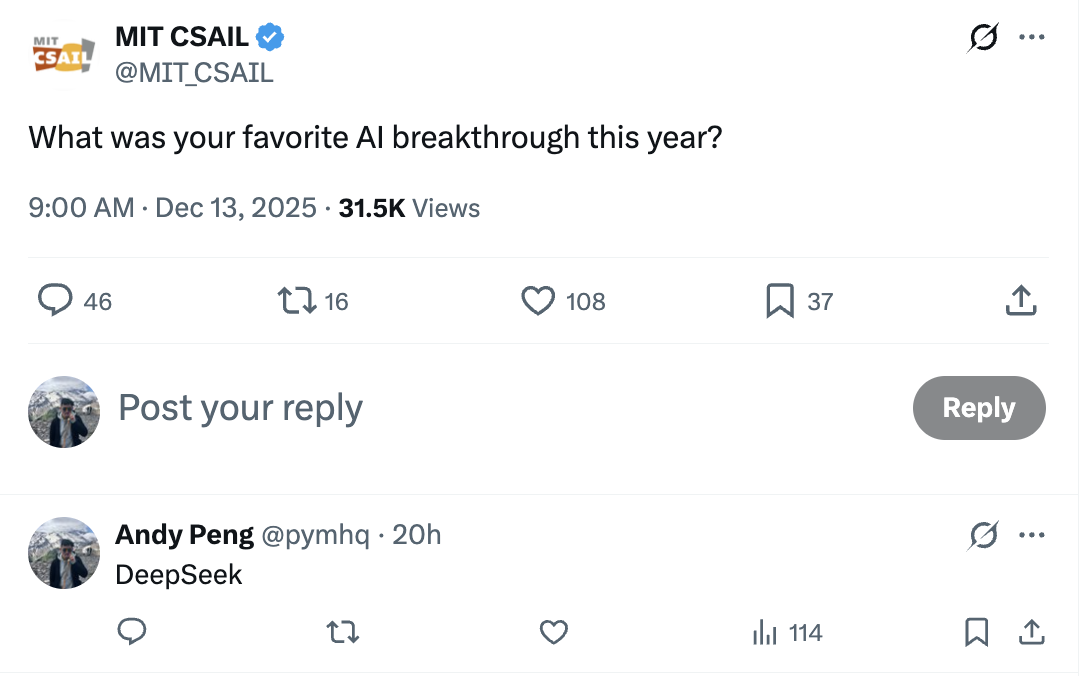
When MIT CSAIL asked on Twitter about everyone's favorite AI breakthrough this year, my answer was clear: DeepSeek.
It’s been about a year since the 2025 DeepSeek moment. Nathan Lambert's 2025 Open Models Year in Review puts DeepSeek, Qwen, and Kimi as the top 3 open-source models in 2025. This recognition is well-deserved and reflects DeepSeek's significant impact on the open-source AI community.
Why DeepSeek Stands Out
Although we have more powerful models like Claude, OpenAI, and innovations like Cursor, Nano Banana this year, DeepSeek's position has not changed. This is especially remarkable given that more companies like Meta and xAI are switching their models to closed-source during this period. Meanwhile, as many labs invest in flashy agentic applications, DeepSeek continues to invest in fundamental research, as reflected in its recent mHC (5 Jan, 2026) and Conditional Memory Engram (12 Jan 2026) papers.
DeepSeek's commitment to openness has not gone unnoticed by the scientific community. Nature featured DeepSeek in a prominent article: "DeepSeek-R1 incentivizes reasoning in LLMs through reinforcement learning" published on September 17, 2025. Shortly after, on December 8, 2025, Nature recognized Liang Wenfeng as part of Nature's 10, a list of people who shaped science in 2025.
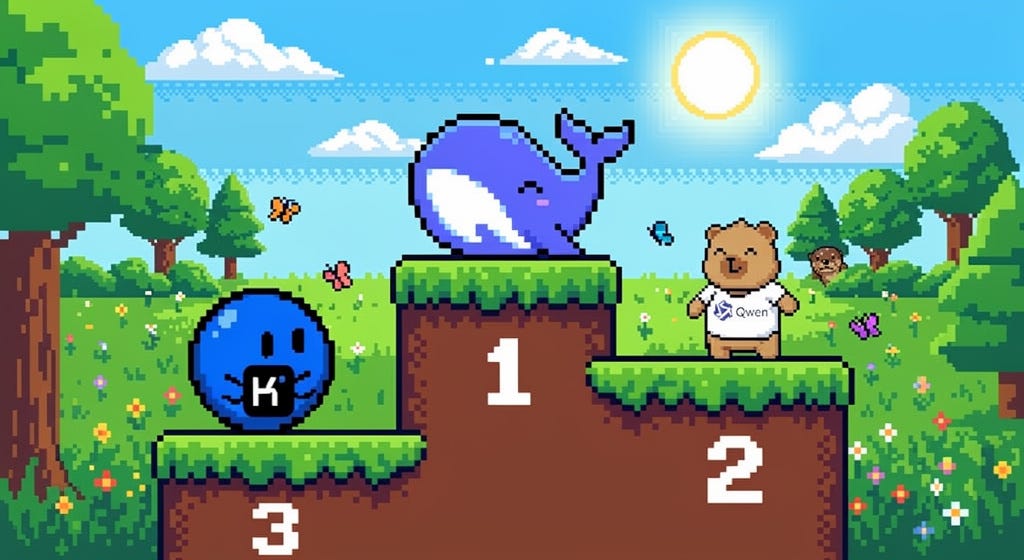
Credit to @natolambert for this adorable image
DeepSeek in Practice: A New Book
As an open-source enthusiast, it's a pleasure to contribute back to the community. I'm excited to announce the publication of "DeepSeek in Practice: From basics to fine-tuning, distillation, agent design, and prompt engineering of open source LLM", published on November 21, 2025.

I am responsible for Chapters 1, 2, and 4, with the rest co-authored by Alex and Durate. The book covers:
- Chapter 1: What is DeepSeek?
- Chapter 2: Deep Dive into DeepSeek
- Chapter 3: Prompting DeepSeek
- Chapter 4: Using DeepSeek: Case Studies
- Chapter 5: Building with DeepSeek
- Chapter 6: Agents with DeepSeek
- Chapter 7: DeepSeek-Driven Fine-Tuning of Gemma 3 for Legal Reasoning
- Chapter 8: Deploying DeepSeek Models
The Journey to Publication
I got connected with Packt Publishing back in 2022, after I led a feature launch in the Containers department and got the chance to talk about it on a YouTube channel. Packt initially wanted me to write a book about serverless and containers. We came up with an outline but didn't continue through at that time. I kept this connection since then.
Last year, when I saw Packt published a book about Bedrock, I was excited as I am in the same product department. This year in May, I received a message invitation from Gebin, the Director of GenAI Content Publishing and Partnerships asking if I was interested in co-authoring a book about the open-source model DeepSeek. At the same time, I happened to be transitioning my research toward open-source LLM optimization and had looking into DeepSeek-R1 (671B).
At that time, I was hesitant as I knew bandwidth was limited, so I was transparent about this situation. Thanks to Gebin, VG (our editor), and Prajakta for supporting me to make this book completed.
Keeping Content Fresh in a Fast-Moving Field
Initially, I was worried about the industry pace changing so quickly. Nearly every two weeks there is a new model coming up. Would this book fall behind the latest industry news when it's published?
I got mental support from my colleague Raj, the Principal Engineer on our team. He said not to worry about content becoming stale—it's always good to give back to the community for people who are not experts or closely on the front lines of this LLM domain. I feel deeply grateful for those words, and I sincerely thank my manager Rakesh, Xu, and my colleague Sid, along with Raj, for their continued support.
Fortunately, when we published the book, our content was still fresh. Of course, in between, we incrementally added content based on the latest model updates. Though we still didn't get a chance to catch up with DeepSeek v3.2: "DeepSeek-V3.2: Pushing the Frontier of Open Large Language Models" submitted on December 2, 2025, to arXiv.
That's really the DeepSeek way—no on-purpose marketing, just shooting out a paper on arXiv or open weights on HF. I like it.
Why DeepSeek Still Matters
Even today, I know lots of people prefer to use smaller models like Qwen, but DeepSeek has its unique advantages. This book shares with you how to use it in practice.
In a sense, DeepSeek's open-sourcing this year has provided the industry with a new option to foundational large models, while breaking down the barriers of previously closed models. This significance is long-term. I have seen more than one organization learning from and researching DeepSeek, including optimizing it, which promotes the openness and development of the entire industry ecosystem.
Numerous implementations already exist, such as MCP, vLLM, and SGLang, as well as the most recent Xiaomi MiMo and OLMo releases.
The open-source ecosystem is in place.
Open source is the way.
