My Story with Anthropic我与 Anthropic 的故事

"The thing I'm most proud of is that we got to build something at the frontier, and a few of us got to watch it become the thing everyone now takes for granted."
A feeling I kept coming back to, writing this.
Some stories you only notice you were living once they've already become history. Mine with Anthropic is one of those. I didn't set out to have a "story with Anthropic." I set out to build an inference engine. But across three and a half years I had the rare seat of both collaborator and observer: close enough to debug a launch at 3 a.m. with their engineers, and far enough back to watch a company go from "Claude? what's that?" to a household name worth nearly a trillion dollars.
This post is that story, told along its timeline. I've drawn the arc as a diagram first, then walked through it chapter by chapter: partly a record of the collaboration, partly an honest log of what I observed from the inside as the frontier moved.
The Arc, at a Glance
The whole story compresses into a single rail: from the day I became engineer No. 2 on a confidential project, to a future milestone I've left blank on purpose:
Joined a newly funded Bedrock Inference team, the only team building serverless inference for Anthropic's Claude models on AWS. Secured codebase, confidential program.
Led nearly all of Claude's Day-0 releases on Bedrock: Claude 3 Opus, 3.5 Sonnet, Computer Use (Anthropic's first agentic feature), and the first Claude on AWS Trainium/Inferentia. At CVPR 2024, most people still didn't know what Claude was.
Anthropic became widely recognized across the industry. Claude Code shipped in May 2025. I stepped sideways from 3P (Claude) into open-weights and speculative-decoding research, but kept watching.
Regular users worldwide, including in China, became fluent in Claude. Anthropic's valuation reached ~$965B by mid-2026: a 50×+ jump in two years, the world's most valuable startup.
The chapter not yet written. Placeholder, date TBD.
My Anthropic timeline: the hollow, dashed node is the future, not yet lived.
Anthropic's valuation across its whole life: from its 2021 founding (~$550M), through the quiet years and the ~$18B mark when Amazon invested (2024), to ~$183B (2025) and ~$965B (mid-2026), with the IPO still a dashed line into the unknown. (Vertical axis is log-scaled so the early years stay visible.)
Engineer No. 2: a confidential beginning
The Inference team was newly funded when I joined in late 2023. I was the first engineer hired, alongside one L6 engineer who'd come over from Lex, which made me, in effect, engineer No. 2. The mandate was privileged and confidential: build the inference engine for Anthropic's models on Amazon Bedrock. For nearly a year our work was shrouded in secrecy: for partner-protection and IP reasons (on Anthropic's behalf), even other Bedrock teammates couldn't access our codebase, documents, or channels. For a long stretch, owing to org restructuring, I was even the only L6 senior engineer on the team.
From the very start, ours was the only team working directly with Anthropic. I still remember an L7 colleague Slack-messaging me early on: "Andy, good to meet you. I've heard your name mentioned even by [the co-founder of Anthropic], when we were working on this project." It's a humbling thing, to learn your name is being said in rooms you've never been in.
This was, once again, a 0→1 startup (clean code, high visibility, fast pace), except this one sat inside what would become the most important business at the company.
Building Together: Day-0 launches, late nights, and Trainium
We partnered directly with Anthropic, including co-founder Ben Mann, with two-plus working sessions a week and a monthly happy hour to celebrate each new model release. That work touched ideas that have since become standards across the open-source inference community, learn more in my other blog post →
In mid-to-late 2024, Ben told me he'd hired a new team to take over the day-to-day partnership work, and that he was starting to hand off so he could spend more time on exploration and research-experiment directions at Anthropic. We now know that's what came next for him: Anthropic Labs, the internal incubator he'd go on to lead, back when neither Claude Code nor MCP existed yet (more on Anthropic Labs →).
Through 2024 I led almost all of Claude's Day-0 public releases on Bedrock. The cadence was relentless: roughly one or two major launches a month, full story in Bedrock 1 Year →
- April: Claude 3 Opus on Amazon Bedrock.
- May: Claude 3 Sonnet and Haiku in Frankfurt.
- July: Claude 3.5 Sonnet.
- October: upgraded Claude 3.5 Sonnet v2 with Computer Use, Anthropic's first agentic-AI feature.
- November: Claude 3.5 Haiku GA; Anthropic + Palantir bringing Claude to the U.S. government cloud.
- December: prompt caching, latency-optimized inference, and Claude 3.5 Sonnet in the AWS Top Secret cloud (re:Invent).
I also delivered the first Claude model on AWS Trainium/Inferentia, partnering with James Bradbury (Anthropic's Head of Compute) and the Annapurna teams. There's a serendipity I still smile at: through my Linux Foundation community work I'd been invited to San Francisco on the PyTorchCon Program Committee, where I sat on a panel alongside James. The following week, back in Seattle, I found myself working with him full-time on Claude on Trainium. You meet someone outside of work, and a week later you're shipping a frontier launch together.
I vividly recall several late nights where both teams worked until sunrise to debug a launch, and the happy hours afterward in Seattle's South Lake Union that made the exhaustion worth it. This was also the first time I felt how intensely Amazon's most senior leadership cares about a business: we took tickets directly from customer CEOs, and every Sev-2 review pulled in L10 leaders (our VP and a Distinguished Engineer) alongside L8 Senior Principal Engineers.
And here is the part that dates this chapter most precisely: when I told people at CVPR 2024 that I worked on the Claude model, I'd often get a blank look. They didn't know what it was. Anthropic was, at that point, a frontier lab valued at roughly $18 billion: serious money, but not yet a name your family would recognize.
The Year It Clicked: industry recognition & Claude Code
2025 was the year the wider industry caught up to what we'd been living. Anthropic became widely recognized across the field, and in May 2025 the company released Claude Code, the tool that, more than any single model, made developers everywhere fluent in the name "Claude." SemiAnalysis would later estimate Bedrock as a multi-billion-dollar run-rate business with the vast majority of its customers (80–90%+) on Anthropic models.
"SemiAnalysis believes Bedrock is a $5.5B run rate business today with the vast majority of customers (80-90%+) using Anthropic models."
After shipping my last 3P task in Q1 2025, I chose to step sideways. Bedrock Inference was organized into 3P (Claude and other closed models), 2P (open-weights: Gemma, gpt-oss, Qwen, DeepSeek), and 1P (Amazon's own Nova and Titan). I moved from 3P into 2P, beginning my research line in model optimization (speculative decoding) and customization, the work I still lead today. I left the Claude program, but I never stopped watching it.
Everyone Uses Claude: from frontier to household name
By 2026 the blank looks were gone. Regular users worldwide, including people in China, had become familiar with Claude and were learning, on their own, how to use it well. The thing a handful of us had built behind a badge-locked door had quietly become part of everyday life.
There is one number from this year I find hard to look at without feeling something. In 2Q26, SemiAnalysis put more than 40% of Anthropic's ARR through indirect channels: Amazon Bedrock, Microsoft Foundry, and Gemini Agent Enterprise, with Bedrock the largest of the three. Their own chart makes the second half of that plain: Bedrock grew from roughly $150M in a quarter in 1Q25 to a forecast $9.3B in 4Q26, and about 40% of Anthropic's API revenue now arrives through it. The serverless endpoint a handful of us stood up behind a locked door, the one I had to explain at CVPR in 2024, is now one of the main doors that revenue walks through.
Four in every ten of Anthropic's ARR dollars now arrive through someone else's console.
- Indirect: Amazon Bedrock, Microsoft Foundry, Gemini Agent Enterprise. The customer pays a cloud bill, and Anthropic is the seller of record.
- Direct: Anthropic's own API, the Claude apps and subscriptions, and enterprise contracts signed directly.
- Amazon Bedrock revenue, $M per quarter
- Share of Anthropic's API revenue via Bedrock
The 1Q26 bar, roughly $1.37B in a quarter, is the $5.5B run rate quoted above. Note that this 40% and the 40% in the panel above are different measurements that happen to land on the same number: this one is Bedrock's share of Anthropic's API revenue, the one above is all indirect channels' share of total ARR.
I want to be careful about what that chart does and does not say. It is not my number. It is Anthropic's revenue, and the channel carries vastly more than the code any one engineer wrote into it. But the shape of it is the thing: a frontier lab now reaches a large share of its customers through a console someone else operates, and being the seller of record on that console was a structure Anthropic did first, with AWS. In 2024 we were arguing about token accounting and cold-start latency on a service most people had never heard of. It turns out we were building a distribution channel.
I watched Anthropic itself grow up close: from a team of fewer than 200 people to what it is today, its valuation climbing from roughly $18B in 2024 to ~$965B by mid-2026. More than a 50× jump in two years, making it the world's most valuable startup. Some of the most valuable parts of this chapter weren't in any codebase at all. They were the people the work put me next to: engineers, founders, researchers, and investors I now count as part of my network.
Trust and Safety: the philosophy underneath everything
If there's one thing that stayed constant across every person I worked with at Anthropic, model release after model release, it's this: AI safety is a root philosophy, not a checkbox. As early as 2023, Anthropic published its Responsible Scaling Policy, defining a framework of AI Safety Levels (ASL): safety, security, and operational standards that scale up as a model's capability, and its potential for catastrophic risk, scales up.
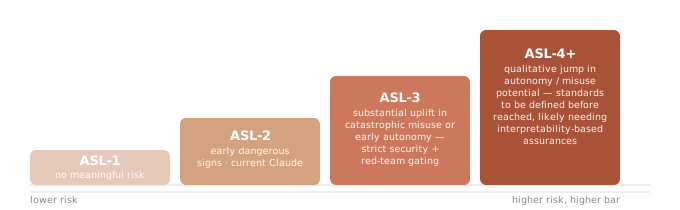
CEO Dario Amodei has said as much himself, in different settings and in his own words, about how much weight trust and safety carries in the company's decisions. I saw that weight directly. I was one of the engineers who helped build, alongside Anthropic, multiple safety-system ecosystems for trust-and-safety control of increasingly powerful models, for every model release we shipped together. There was very little room for compromise in that process. Of every model provider I've worked with or watched, I have never seen one take it as seriously as Anthropic does.
That commitment extends into research, not just policy. Anthropic's recent interpretability work (Global Workspace and Tracing the Thoughts of a Language Model) is, to me, part of the same lineage: understanding why a model does what it does is a prerequisite for trusting it at scale. That kind of work is a safeguard for the whole trajectory toward AGI. Anthropic has done the work to lay that foundation solidly, and it's what lets the rest of us keep building on top of it with confidence.
The Chapter Not Yet Written: the IPO
Every arc this steep eventually reaches a public-market milestone. As I write this, Anthropic's IPO is still ahead of us, a date I genuinely don't know yet, and so one I'm deliberately leaving blank. When it lands, this is where I'll mark it.
When I think back over this whole timeline, what stays with me isn't any single launch. It's the strange privilege of the double seat: building the thing and watching it become history at the same time. In 2024 I had to explain what Claude was; in 2026 I no longer have to explain anything. The rest of that story, Anthropic gets to write. I just got to be there for the beginning.
"我最自豪的,是我们得以在前沿造出某样东西,而我们少数几个人,亲眼看着它变成了如今人人习以为常的存在。"
写这篇文章时,我反复回到的一种感受。
有些故事,你只有在它们已成为历史之后,才意识到自己曾身在其中。我与 Anthropic 的故事就是其一。我并非一开始就想拥有一段"与 Anthropic 的故事"。我只是想造一个推理引擎。但在三年半里,我有幸同时坐在合作者与旁观者两个席位上:近到能在凌晨三点和他们的工程师一起调试一次发布,又远到能看着一家公司从"Claude?那是什么?"成长为一个市值近万亿美元、家喻户晓的名字。
这篇文章就是那个故事,沿着它的时间线讲述。我先把这条弧线画成一张图,再逐章走过:既是合作的记录,也是我在前沿不断移动时、从内部观察到的一份诚实日志。
弧线一览
整个故事压缩成一条轨道,从我成为一个机密项目的 2 号工程师那天,到一个我刻意留白的未来里程碑:
加入新获立项的 Bedrock 推理团队,这是在 AWS 上为 Anthropic 的 Claude 模型构建无服务计算推理的唯一团队。代码库受保护,机密项目。
主导了 Claude 在 Bedrock 上几乎所有的 Day-0 发布:Claude 3 Opus、3.5 Sonnet、Computer Use(Anthropic 首个智能体功能),以及首个跑在 AWS Trainium/Inferentia 上的 Claude。在 CVPR 2024,大多数人还不知道 Claude 是什么。
Anthropic 在业界广受认可。Claude Code 于 2025 年 5 月发布。我从 3P(Claude)转向开源权重与投机解码研究,但一直在关注。
全球普通用户,包括中国,都熟练使用 Claude。到 2026 年年中,Anthropic 估值达到 约 9650 亿美元:两年里增长 50 倍以上,成为全球市值最高的初创公司。
尚未书写的一章。占位,日期待定。
我的 Anthropic 时间线:空心虚线节点是尚未经历的未来。
Anthropic 估值的一生:从 2021 年成立(约 5.5 亿美元),经过沉静岁月与 Amazon 投资时的 约 180 亿美元(2024),到 约 1830 亿美元(2025)与约 9650 亿美元(2026 年年中),IPO 仍是一条通向未知的虚线。(纵轴为对数刻度,以便早期年份仍清晰可见,单位:美元。)
2 号工程师:一个机密的开端
我在 2023 年底加入时,推理团队刚刚获得立项。我是第一位入职的工程师,另有一位从 Lex 转来的 L6 工程师,这实际上让我成了 2 号工程师。任务既受信任又保密:在 Amazon Bedrock 上构建 Anthropic 模型的推理引擎。在近一年里,我们的工作笼罩在保密之中:出于合作伙伴保护与知识产权原因(代表 Anthropic),连其他 Bedrock 同事都无法访问我们的代码库、文档或频道。在很长一段时间里,因为部门调整,我甚至是团队里唯一一个 L6 高级工程师。
从一开始,我们就是唯一直接与 Anthropic 合作的团队。我仍记得早期一位 L7 同事在 Slack 上对我说:"Andy,很高兴认识你。在我们做这个项目时,我甚至听到 [Anthropic 的联合创始人] 提起过你的名字。" 得知自己的名字出现在你从未踏入的房间里,是件令人谦卑的事。
这又一次是一个 0→1 的创业(干净的代码、高曝光、快节奏),只不过这一次,它坐落在将成为公司最重要业务的核心之中。
并肩共建:Day-0 发布、深夜与 Trainium
我们直接与 Anthropic 合作,包括联合创始人 Ben Mann,每周两次以上的工作会议,每月一次 happy hour 庆祝每个新模型发布。那些工作触及的理念,如今已成为开源推理社区的标准,在我的另一篇博客中了解更多 →
2024 年中下旬,Ben 告诉我他已经招募了一支新团队,来接手日常的合作对接工作,他准备启动交接,把更多精力投入到 Anthropic 内部的探索与研究实验方向。后来我们才知道,那正是他的下一站:Anthropic Labs,他后来主导的内部孵化团队,而彼时 Claude Code 和 MCP 都还未诞生(了解 Anthropic Labs 更多信息 →)。
整个 2024 年,我主导了 Claude 在 Bedrock 上几乎所有的 Day-0 公开发布。节奏紧锣密鼓:大约每月一到两次重大发布,详见《Bedrock 一周年回顾》 →
- 四月:Claude 3 Opus 登陆 Amazon Bedrock。
- 五月:Claude 3 Sonnet 与 Haiku 在法兰克福上线。
- 七月:Claude 3.5 Sonnet。
- 十月:升级版 Claude 3.5 Sonnet v2,带来 Computer Use,Anthropic 首个智能体 AI 功能。
- 十一月:Claude 3.5 Haiku 正式发布(GA);Anthropic 与 Palantir 一起把 Claude 带入美国政府云。
- 十二月:提示缓存、延迟优化推理,以及 Claude 3.5 Sonnet 进入 AWS 绝密云(re:Invent)。
我还交付了 首个跑在 AWS Trainium/Inferentia 上的 Claude 模型,与 James Bradbury(Anthropic 计算负责人)及 Annapurna 团队合作。有一段缘分我至今想起仍会微笑:通过我在 Linux 基金会的社区工作,我受邀以 PyTorchCon 项目委员会成员身份前往旧金山,与 James 同台。第二周回到西雅图,我就发现自己在全职和他一起做 Claude on Trainium。你在工作之外遇见某人,一周后就和他一起交付一次前沿发布。
我清晰记得有好几个深夜,两个团队一起工作到日出来调试一次发布,以及之后在西雅图 South Lake Union 的 happy hour,让那份疲惫变得值得。这也是我第一次感受到 Amazon 最高层领导对一项业务的在意程度:我们直接接收来自客户 CEO 的工单,每一次 Sev-2 复盘都会拉入 L10 领导(我们的 VP 和一位杰出工程师,即 Distinguished Engineer),以及 L8 高级首席工程师。
而最能精确标定这一章年代的,是这件事:当我在 CVPR 2024 告诉别人我做 Claude 模型时,常常得到一脸茫然。他们不知道那是什么。彼时的 Anthropic 是一家估值约 180 亿美元 的前沿实验室:是笔不小的钱,但还不是一个你家人会认得的名字。
豁然开朗的一年:业界认可与 Claude Code
2025 年,更广阔的业界终于追上了我们一直身处其中的现实。Anthropic 在整个领域广受认可,并在 2025 年 5 月发布了 Claude Code,这个工具比任何单个模型都更让各地开发者熟悉"Claude"这个名字。SemiAnalysis 后来估计 Bedrock 是一项数十亿美元营收规模的业务,其绝大多数客户(80–90%+)使用 Anthropic 模型。
"SemiAnalysis 认为,Bedrock 如今是一项 55 亿美元营收规模的业务,绝大多数客户(80-90%+)使用 Anthropic 模型。"
在 2025 年 Q1 交付了我最后一个 3P 任务后,我选择转身。Bedrock 推理团队分为 3P(Claude 等闭源模型)、2P(开源权重:Gemma、gpt-oss、Qwen、DeepSeek)与 1P(Amazon 自家的 Nova 与 Titan)。我从 3P 转入 2P,开启了我在 模型优化(投机解码) 与定制方向的研究线,也就是我今天仍在带领的工作。我离开了 Claude 项目,但从未停止关注它。
人人都用 Claude:从前沿到家喻户晓
到了 2026 年,茫然的表情消失了。全球普通用户,包括中国的人们,都已熟悉 Claude,并在自学如何用好它。我们少数几个人在一扇刷卡才能进的门后造出的东西,已悄然成为日常生活的一部分。
今年有一个数字,我很难毫无触动地看着它。2026 年二季度,SemiAnalysis 估算 Anthropic 有超过 40% 的 ARR 来自间接渠道:Amazon Bedrock、Microsoft Foundry 与 Gemini Agent Enterprise,其中 Bedrock 规模最大。他们自己那张图把后半句说得很直白:Bedrock 的季度营收从 2025 年一季度的约 1.5 亿美元,长到 2026 年四季度预测的 93 亿美元,而 Anthropic 的 API 收入如今约有 40% 是经由它进来的。我们少数几个人在一扇上锁的门后立起来的那个无服务计算端点,那个我在 2024 年 CVPR 上还得逐句解释的东西,如今成了营收走进来的主要几扇门之一。
如今 Anthropic 每十美元 ARR 里,有四美元是从别人的控制台进来的。
- 间接:Amazon Bedrock、Microsoft Foundry、Gemini Agent Enterprise。客户付的是云账单,而 Anthropic 是销售记录方(seller of record)。
- 直接:Anthropic 自家 API、Claude 应用与订阅,以及直接签下的企业合同。
- Amazon Bedrock 营收(百万美元 / 季)
- Anthropic API 收入经由 Bedrock 的比例
2026 年一季度那根柱子约 13.7 亿美元,年化就是上文引用的 55 亿美元 营收规模。请注意:这里的 40% 和上一面板的 40% 是两个不同口径,只是恰好落在同一个数字上。这里指 Bedrock 占 Anthropic API 收入的比例,上面指全部间接渠道占总 ARR 的比例。
我想谨慎地说清这张图说了什么、又没说什么。它不是我的数字。那是 Anthropic 的营收,而这条渠道承载的东西,远远多于任何一位工程师写进去的代码。但它的形状本身才是重点:一家前沿实验室,如今有很大一部分客户是通过别人运营的控制台触达的,而在那个控制台上充当销售记录方,是 Anthropic 最先和亚马逊云科技一起做成的结构。2024 年,我们还在为一个多数人没听过的服务争论 token 计数与冷启动延迟。原来我们建的是一条分发渠道。
我近距离看着 Anthropic 自身成长:从一个不到 200 人的团队,长成今天的模样,估值从 2024 年的约 180 亿美元 攀升到 2026 年年中的约 9650 亿美元。两年里增长超过 50 倍,使其成为全球市值最高的初创公司。这一章里最宝贵的部分,有些根本不在任何代码库中,而是工作让我结识的人:工程师、创始人、研究者与投资人,如今都成了我人脉的一部分。
信任与安全:贯穿始终的根本理念
在我与 Anthropic 合作、共事过的每一个人身上,无论经历了多少次模型发布,有一件事始终没有变过:AI 安全是一种根本理念,而不是一项打勾了事的合规清单。早在 2023 年,Anthropic 就分享了其负责任扩展政策(Responsible Scaling Policy),定义了一套 AI 安全等级(ASL,AI Safety Levels)框架:安全性、安全保障与运营标准会随着模型能力的提升、以及其潜在灾难性风险的上升而同步提高。
CEO Dario Amodei 本人也在不同场合,用他自己的话多次谈到信任与安全在公司决策中的重视程度。我直接感受到了这份重视。我是参与其中的工程师之一,和 Anthropic 一起,为持续增强的模型搭建了多个安全系统生态(safety-system ecosystem),用于每一次我们共同交付的模型发布中的信任与安全控制。这个过程中,妥协的空间非常小。在我合作过或观察过的所有模型提供方里,我从未见过任何一家像 Anthropic 这样重视这件事。
这份投入不止停留在政策层面,也延伸到了研究本身。Anthropic 近期的可解释性研究(Global Workspace 与 Tracing the Thoughts of a Language Model)在我看来,属于同一条脉络:理解一个模型为什么会这样做,是在更大规模上信任它的前提。这类工作是通往 AGI 这整条路径上的保障。Anthropic 把这一基础打得足够坚固,也正因如此,我们其他人才能继续放心地在这个基础上向前建造。
尚未书写的一章:IPO
每一条如此陡峭的弧线,最终都会抵达一个公开市场的里程碑。写下这段时,Anthropic 的 IPO 仍在我们前方,一个我确实还不知道的日期,所以我刻意留白。当它到来时,我会在这里标记。
当我回望整条时间线,留在我心里的并不是某一次发布,而是那"双重席位"的奇异荣幸:一边造着这件事,一边看着它同时成为历史。2024 年我还得解释 Claude 是什么;2026 年我已无需解释任何东西。故事余下的部分,交由 Anthropic 去书写。我只是有幸见证了它的开端。