Lunch with CTO of The Linux Foundation & PyTorch Foundation Matt White与 Linux 基金会及 PyTorch 基金会 CTO Matt White 的午餐

"Open source is not a license — it's a supply chain and a community."
— a paraphrase of the afternoon
Update (July 2026): Matt is at the WAIC 2026 (World Artificial Intelligence Conference) opening ceremony in Shanghai — see his post.
Last month at MLSys 2026 in Bellevue, I had lunch with Matt White — Global CTO of AI at the Linux Foundation, CTO of the PyTorch Foundation, and CTO of the newer Agentic AI Foundation (among a long list of open-source roles, from LF AI & Data to the Generative AI Commons). It was the kind of conversation that only happens in person, and it had been a couple of years in the making.
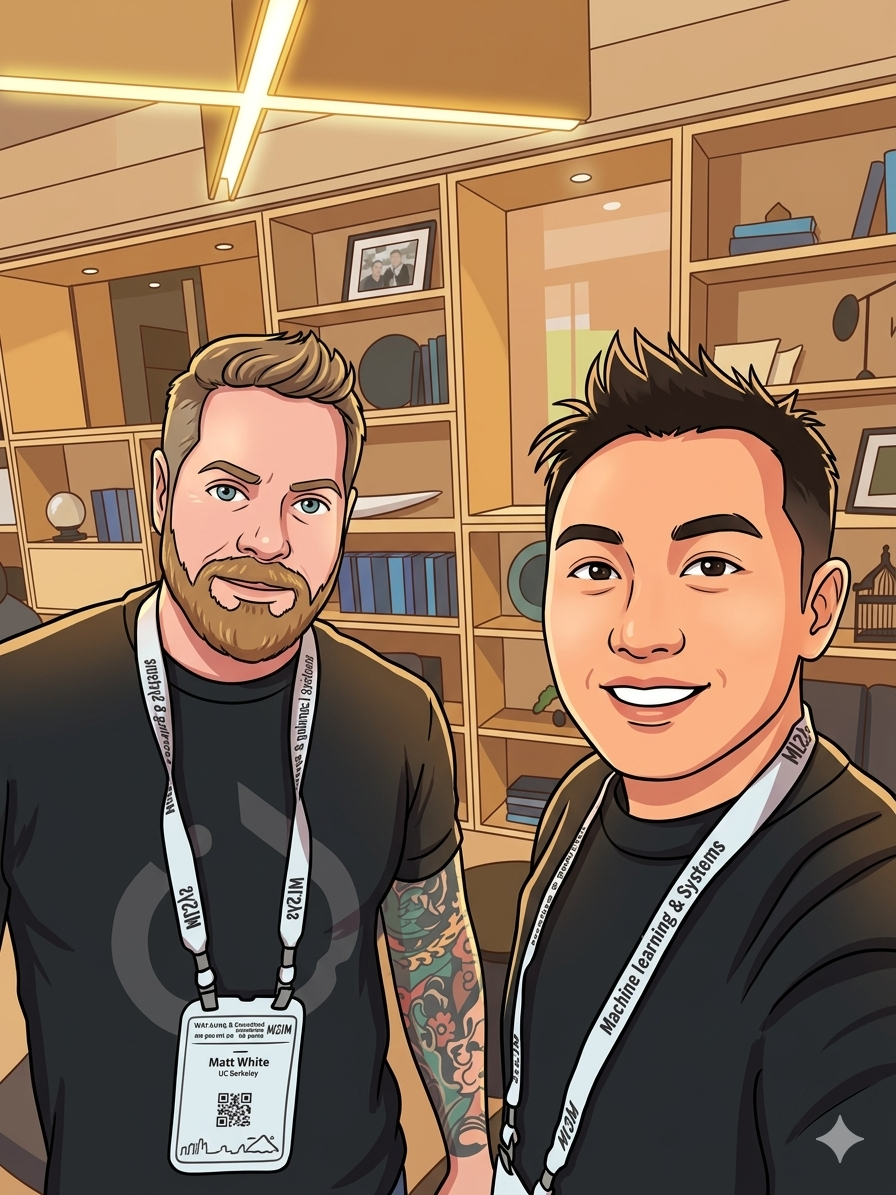
How we (finally) met
Matt and I first connected on LinkedIn back in 2024, when he was CTO of LF AI & Data and the large-model era was just beginning (ChatGPT had only launched in November 2022). That year we were both at the PyTorch Conference in San Francisco and somehow missed each other. So I kept up the other way: reading what Matt writes and shares, most recently his excellent field report, "Eight Days in China: A Field Report from Inside the Labs."
Because I've spent the last few years contributing to the Linux Foundation community, and we already knew each other, lining up a meeting during MLSys week came together naturally. We bumped into each other at the venue on 5/18, and set a lunch for 5/19.
The booth and the brunch
When I found Matt on the 19th, he was still at the PyTorch booth — hands-on, debugging a stubborn USB connection on the demo screen. Very on-brand for someone who runs foundations and still fixes the hardware. I pulled him away and we walked over to Cafe Hagen, a cozy brunch spot nearby (avocado toast included), where we traded notes on what each of us has been building lately.
Every foundation needs an "anchor project"
Matt talked about his work at the Agentic AI Foundation and his earlier years at IBM. I asked the question I'd been saving: how does he see the Silicon-Valley-hot space of world models and robotics — the kind of work Fei-Fei Li and others are pushing into multimodal, spatial intelligence — and does the Linux Foundation have plans there?
He's studying it, he said, but the honest answer is that a credible open movement needs an anchor project to rally around first. The pattern repeats across the open ecosystem:
A movement coalesces around one indispensable project. World models and robotics don't have their open anchor yet — finding (or seeding) it is the hard part.
He shared sharp observations about which companies are quietly building these capabilities in-house versus leaning on open foundations — and where the gaps are.
Open-weights frontier models & the supply chain
That led us into open-weights frontier models. Matt's read: the U.S. doesn't really have an open-weights frontier model right now — Google's open releases being the notable exception — and the country still needs to build up the supply chain around open models (data, weights, tooling, evals, distribution). His point was that China is doing this remarkably well: a dense, fast-moving open-weights ecosystem. It reframed "open source AI" for me as less of a licensing question and more of an industrial one — a supply chain and a community, not just a repo.
Eight days in China
Naturally I asked about his China trip. He lit up — visiting labs and companies across Hangzhou, Shenzhen, and beyond, and (of course) the food. If you haven't read his field reports, they're the most grounded "inside the labs" accounts I've seen this year — see also "From Code to Cognition: How LLMs & VLAs…". He also mentioned he'd be heading back to China soon after MLSys, for BEYOND Expo. Afterward we walked to the Starbucks near the conference hotel and grabbed drinks.
A French grandmother, a phone, and Gemini
The best moment wasn't on the agenda. On our way to lunch, an elderly French lady stopped us — her English wasn't fluent — holding up her phone with Gemini open, asking how to get to the Old Navy at Factoria. The mall turned out to be far from where we were standing. I don't speak French; Matt did, and helped her sort it out.
We laughed about it afterward: AI has genuinely reached every generation and woven itself into daily life — a French grandmother navigating a foreign city with a model in her pocket. That's the adoption curve no benchmark captures.
Again, at the Together AI meetup
That evening I ran into Matt once more — at the Together AI meetup. We picked the thread back up on open-source AI community building: how to grow contributors, how to keep neutral governance, and how to give a new direction its anchor.
Two takeaways I'm still chewing on: open source AI is a supply chain, not a checkbox; and every new direction — world models included — waits on someone willing to build its anchor. Grateful to Matt for the time, the French translation, and the perspective.
Build in the open. Then bring people along.
“开源不是一纸许可证——它是一条供应链,也是一个社区。”
—— 当天午后的一句概括
更新(2026 年 7 月):Matt 在上海 WAIC 2026(世界人工智能大会)开幕式现场——查看他的推文。
上个月,在 Bellevue 举办的 MLSys 2026 上,我和 Matt White 一起吃了顿午饭—— 他是 Linux 基金会的全球 AI CTO、PyTorch 基金会的 CTO,也是新近成立的 Agentic AI 基金会的 CTO(此外还有一长串开源相关的身份,从 LF AI & Data 到 Generative AI Commons)。 这是那种只有当面才聊得开的对话,而这次见面也酝酿了好几年。
我们是怎么(终于)见上面的
我和 Matt 最早是在 2024 年通过领英连接上的,那时他是 LF AI & Data 的 CTO,大模型时代才刚刚拉开序幕 (ChatGPT 直到 2022 年 11 月才发布)。 那一年我们都在旧金山的 PyTorch 大会现场,却擦肩而过没能见上。于是我换了种方式保持关注:一直读 Matt 写的东西和分享, 最近的就是他那篇出色的一线报告, 《在中国的八天:来自实验室内部的一线报告》。
因为过去几年我一直在为 Linux 基金会社区做贡献,加上我们本就相识,要在 MLSys 这一周约个见面便水到渠成。 我们 5/18 在会场偶遇,约好 5/19 一起午餐。
展台与早午餐
5 月 19 日我找到 Matt 时,他还守在 PyTorch 展台——亲力亲为,正在修一个怎么都不听话的 demo 屏幕 USB 连接。 对一个既掌管着基金会、又还在亲手修硬件的人来说,这画面太贴切了。我把他拉了出来,我们步行去了附近一家温馨的早午餐店 Cafe Hagen(当然少不了牛油果吐司),边吃边交换彼此近来的进展。
每个基金会都需要一个“锚点项目”
Matt 聊到了他在 Agentic AI 基金会的工作,以及更早年在 IBM 的经历。我抛出了憋了很久的问题:他怎么看硅谷当下正热的 世界模型与机器人方向——也就是 李飞飞 等人正在推进的多模态、空间智能那一类工作——Linux 基金会在这个方向上有没有计划?
他说他也在研究,但坦率讲,一个可信的开源运动首先需要一个锚点项目来把大家凝聚起来。这个规律在整个开源生态里反复出现:
一场运动会围绕某一个不可或缺的项目凝聚成形。世界模型与机器人还没有属于自己的开源锚点——找到(或培育出)它,才是最难的部分。
他还分享了一些犀利的观察:哪些公司在悄悄自研这些能力,哪些则依托开源基金会——以及缺口究竟在哪里。
开放权重的前沿模型,与那条供应链
这把我们带到了开放权重的前沿模型上。Matt 的判断是:美国眼下其实还没有真正的开放权重前沿模型——谷歌的开源发布算是个显著例外—— 而且整个国家还需要把围绕开放模型的供应链(数据、权重、工具链、评测、分发)搭建起来。他的观点是中国在这方面做得相当出色: 一个密集而快速迭代的开放权重生态。这让我重新理解了“开源 AI”——它与其说是一个许可证问题,不如说是一个产业问题:一条供应链加一个社区,而不只是一个代码仓库。
在中国的八天
我自然问起了他的中国行。 他一下子来了兴致——走访了 杭州、深圳等地的实验室和公司,当然还有美食。如果你还没读过他的一线报告,那是我今年看到的最接地气的“深入实验室内部”的记录—— 也可以再看看 《从代码到认知:LLM 与 VLA 如何……》。 他还提到,MLSys 之后不久他会再去一趟中国,参加 BEYOND Expo。 之后我们走到会场酒店附近的星巴克,买了点喝的。
一位法国老奶奶、一部手机和 Gemini
最妙的一幕并不在计划之内。去吃午饭的路上,一位法国老太太把我们叫住——她英语不太流利——举着手机,屏幕上开着 Gemini, 问我们怎么去 Factoria 的 Old Navy。结果那家商场离我们所在的地方相当远。我不会说法语;Matt 会,于是帮她把事情说清楚了。
事后我们都笑了:AI 真的已经触达了每一个年龄层,渗进了日常生活——一位法国老奶奶,靠口袋里的一个模型在异国他乡找路。 这条普及曲线,是任何基准测试都刻画不出来的。
再一次,在 Together AI 的 meetup 上
那天晚上我又碰到了 Matt——在 Together AI 的 meetup 上。我们接着白天的话题,聊起了开源 AI 的社区建设: 如何吸引更多贡献者、如何保持中立的治理,以及如何为一个新方向找到它的锚点。
还有两点我仍在回味:开源 AI 是一条供应链,而不是一个打勾项;每一个新方向——包括世界模型——都在等一个愿意去搭建其锚点的人。 感谢 Matt 的时间、那段法语翻译,以及他的视角。
在开放中构建,然后带着大家一起走。