Trendings on Speculative Decoding投机解码(Speculative Decoding)趋势

"The fastest token is the one you never have to generate twice."
— the idea at the heart of every speculative-decoding system
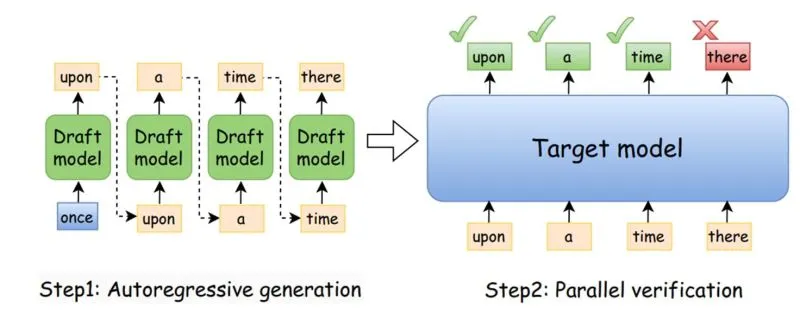
Speculative decoding has quietly become the default way to make large language models fast. The premise is simple: a small, cheap drafter guesses several tokens ahead, and the big target model verifies them in a single parallel forward pass — accepting the guesses it agrees with and correcting the first one it doesn't. Because rejected drafts are thrown away, the output stays bit-for-bit identical to plain autoregressive decoding. It's a pure efficiency win, not a quality trade.
In my own writing on the LLM space — from my LLM Year in Review to my MLSys 2026 recap — I've watched this technique go from a clever trick to a production necessity. What's striking about 2026 is how the whole field converged on the same answer in the span of two months — and from three very different angles: DeepSeek's server-scale DSpark, Google's open Gemma 4 drafters, and Google's on-device Gemini Nano frozen Multi-Token Prediction. This post walks that timeline, summarizes each, lays them side by side — and keeps a running ledger of where they land in production.
The 2026 Wave, at a Glance
Two timelines, one story — both running newest to earliest. First the speculator releases: three launches, eight weeks, one idea — from the open-weights drafters that put speculative decoding in everyone's hands, to the edge, to hyperscale serving. Then the speculator trainers: the open-source training libraries that made those drafters reproducible, a lineage spanning exactly one year, July 2025 to July 2026 (each is covered in detail below).
Speculator Releases — three launches, eight weeks · newest first
Intent Lab's agent fleet re-engineers TensorRT-LLM for GLM 5.2 on Grace Blackwell — 6.3× end to end, with speculative decoding the single largest slice at ×4.0 via optimized DSpark drafters, reaching 647 tok/s. Full breakdown in the adoption ledger.
DFlash lands in production for a day-0 frontier release: Modal serves Thinking Machines' Inkling backed by a custom-trained DFlash speculator — 67% higher throughput and interactivity, running on Modal Auto Endpoints with SGLang. Soumith Chintala: "Modal trained a DFlash speculator that's much faster than MTP, making it a great boost for inference speeds!"
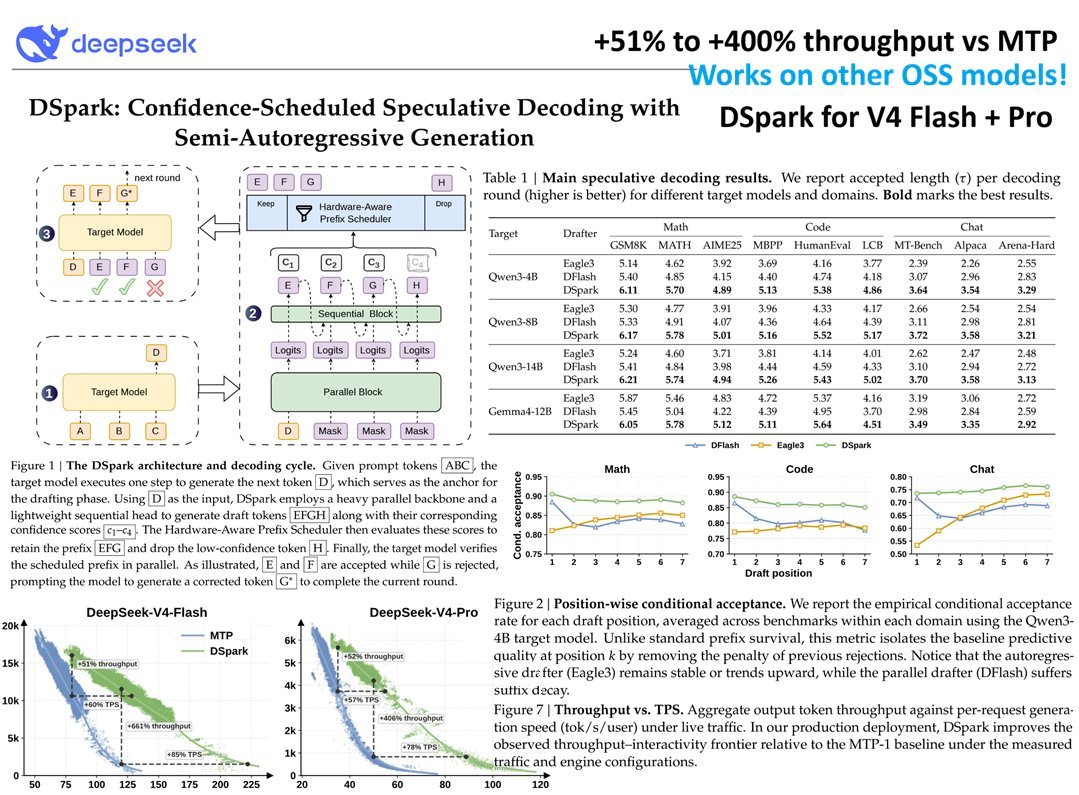
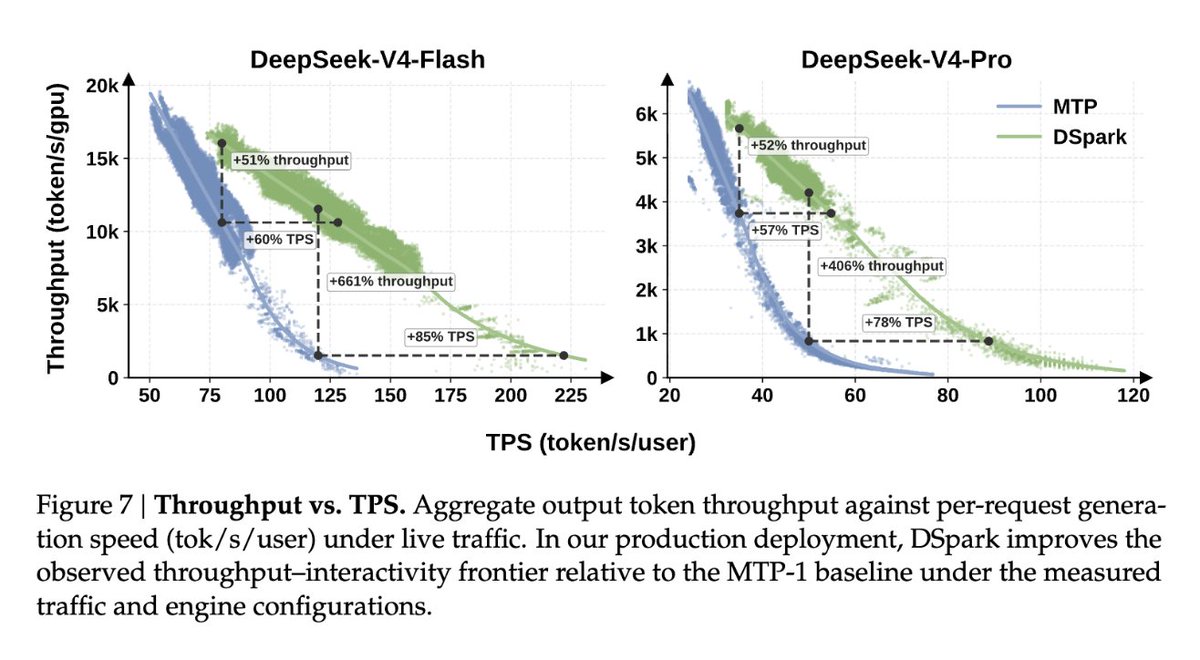
DeepSeek layers a "semi-parallel" speculative framework with confidence-scheduled verification on top of DeepSeek-V4's built-in MTP-1. Per-user speedups of 57–85% and throughput gains of 1.5×–5× in real production traffic.
Google Research retrofits MTP onto frozen Gemini Nano v3 on Pixel 9/10. A "late-exit" head cross-attends to the main model's KV cache (zero-copy), saving ~130 MB and delivering 50%+ speedups with ~2 extra accepted tokens per pass.
Google ships a companion line of autoregressive drafter models — officially the "Gemma 4 Assistant" (the -assistant checkpoints) — plus an MTP head for the Gemma 4 family. Up to 3× faster inference, lossless, Apache-2.0, and supported in Transformers, MLX, vLLM, SGLang and Ollama from day one.
The 2026 speculative-decoding wave, newest first — three launches and the production adoption that followed.
Speculator Trainers — exactly one year, Jul 2025 – Jul 2026 · newest first
An end-to-end framework covering both training and deployment — torch-native training for MTP and block-parallel drafters, released with DFly drafter weights for Hy3-A21B. 1.98–2.40× end-to-end speedup at concurrency 4–64, and 10.5–11.8% higher throughput than DFlash. Announced on X.
The repo DeepSeek open-sourced alongside DSpark — shipping not just the DSpark recipe but DeepSeek's own DFlash and EAGLE-3 drafter training, closing the loop from algorithm research to a runnable production stack.
A torch-native framework for disaggregated drafter training: it decouples the inference engine that generates hidden states from the training workers that consume them, streaming tensors over RDMA/TCP through the Mooncake store — no disk, no co-location. Trains a Kimi K2.5 EAGLE-3 drafter in ~1,500 H200-hours.
Two production pushes in one month. Speculators (vLLM / Red Hat) standardizes drafters into a single Hugging Face format that runs in vLLM out of the box; Amazon SageMaker AI ships EAGLE-2/3 adaptive speculative decoding that retrains heads on your own traffic for ~2.5× throughput.
The first purpose-built EAGLE-3 training framework, natively wired to SGLang so a draft model is deployable the moment training finishes. Built-in Training-Time Test (TTT), online & offline hidden-state modes, FSDP + tensor parallelism, and MoE support (Llama 4, DeepSeek).
A year of training-library releases, newest first — the tooling that turns speculative decoding from a paper into a pipeline.
Key Terms in Plain English — EAGLE, MTP, DFlash
Three names show up everywhere in these announcements. Here's all three explained side by side — plain English first, then the technical details — using the linked sources:
| EAGLE | MTP (Multi-Token Prediction) | DFlash (block-diffusion drafter) | |
|---|---|---|---|
| In one line | A smarter way to draft guesses (a tiny extra layer conditioned on target features). | Teach one model to say several words at once (extra prediction heads). | Draft a whole block at once, by diffusion. |
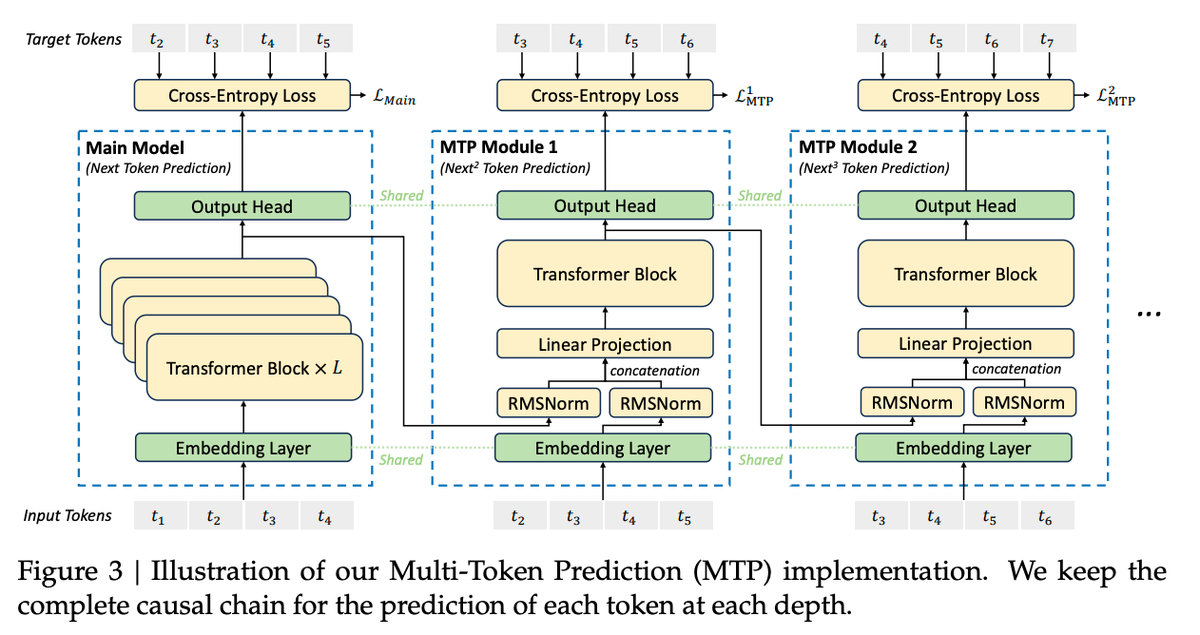
| In plain English | A normal drafter guesses the next word from the words so far. EAGLE instead predicts the big model's internal "thought vector" (its hidden features) one step ahead and drafts from that, so more guesses get accepted — and more acceptances means more speed. | Normally a model writes one token, feeds it back, writes the next — slow and serial. MTP bolts on lightweight extra "heads" that predict the next 2–4 tokens, piggybacking on the model's own embeddings/activations. The big model verifies them in parallel and keeps only the correct ones, so quality is unchanged. | Instead of guessing one token at a time, DFlash uses a block-diffusion model to "paint" all N draft tokens in a single forward pass, still conditioning on the target's hidden features for quality. Drafting latency becomes nearly free, so the bottleneck shifts to draft quality. |
| Drafting style | Autoregressive | Autoregressive | Parallel (non-autoregressive) |
| Passes for K tokens | K sequential | K sequential | 1 — O(1) |
| Conditioning | Target's last-layer feature + previous token (EAGLE-3: multi-layer fusion) | Shares the target's trunk & embeddings | Target hidden features (target-conditioned), bidirectional within the block |
| How it's trained | Train a 1–2-layer draft head on the target's hidden states (cheap) | MTP heads trained with / onto the backbone to predict the next k tokens | Train a lightweight block-diffusion drafter to denoise a K-token block, conditioned on target features |
| Separate drafter model, or model-free? | ~ A small draft head — 1–2 extra trained layers riding on the target (not a full standalone model) | Model-free / integrated — extra heads built into the target itself; no separate model to load | Separate drafter — a lightweight block-diffusion model, trained & shipped per target |
| Strength | High acceptance; coherent on long drafts | Cheap, integrated; rides the model's own compute | Drafting latency ~free; strong at the start of a block; wider blocks ~free on big accelerators |
| Weakness | Serial: latency grows with depth | Serial: K passes for K tokens | Quality can decay deep in the block; needs a diffusion drafter trained per target |
| Where it shows up | The foundation Gemini Nano "builds on." Family: EAGLE-2 (draft trees), EAGLE-3 (training-time test), EAGLE-3.1, P-EAGLE. arXiv:2401.15077. | The shared idea across all three releases: Gemma 4 ships MTP heads; Gemini Nano retrofits one onto a frozen model; DeepSeek-V4 bakes one in (see MTP-1 below). Gemma docs · arXiv:2404.19737. | UCSD Z-Lab, ICML 2026 (arXiv:2602.06036); the "parallel block" half of DeepSeek's DSpark. Distinct from the DeepSeek-V4-Flash model. |
So the clean mental model: EAGLE and MTP are both autoregressive drafters (they differ in where the drafter lives — an extra feature-conditioned layer vs. extra heads), while DFlash is the odd one out: it's parallel, generating the whole block in one shot via diffusion. That single difference — serial vs. one-pass drafting — is the axis the rest of this post turns on.
Bonus term — MTP-1: just "MTP with a single extra head," i.e. one predicted-token-ahead. DeepSeek-V4 ships with MTP-1 built in (2 tokens per forward pass); DSpark then stacks its semi-parallel, confidence-scheduled verification on top of that baseline.
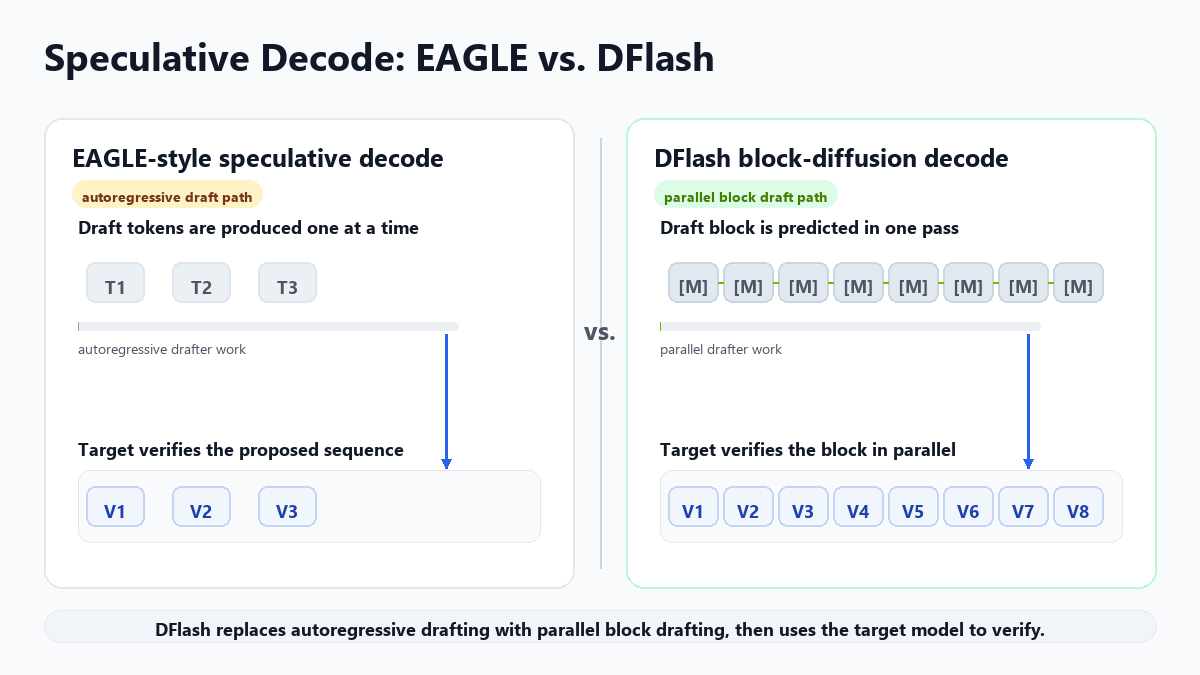
What it is: DFlash ("Block Diffusion for Flash Speculative Decoding", UCSD Z-Lab — Jian Chen, Yesheng Liang, Zhijian Liu; ICML 2026) replaces the autoregressive drafter with a lightweight block-diffusion model. Instead of guessing one token at a time, it "paints" a whole block of K candidate tokens in a single forward pass — turning O(K) serial drafting into O(1).
How it's trained: a small block-diffusion drafter is trained to denoise/produce a block of future tokens, conditioned on context features (hidden states) extracted from the target model — the same EAGLE-style trick that keeps drafts accurate. Drafters are trained per target model on instruction data and published as checkpoints (e.g.
z-lab/LLaMA3.1-8B-Instruct-DFlash-UltraChat, z-lab/Qwen3-4B-DFlash-b16), with a fixed block size K (e.g. 10–16).
How it's used: drop it in as the proposer in a speculative-decoding pipeline; the target verifies the whole block in parallel and keeps the correct prefix (lossless). It's integrated into vLLM (GPU/PyTorch) and vLLM-TPU/JAX (PRs #1868–1870), keeping a context buffer of target hidden states across steps. On TPU v5p a "K-flat" effect makes verifying 16 vs. 1024 tokens cost nearly the same, so wider blocks are ~free and the real lever becomes draft quality. Reported: 3.13× avg (≈6× peak on math) on TPU v5p; 2.29× vs. EAGLE-3's 1.30× head-to-head.
In DSpark: DeepSeek's DSpark blends DFlash's parallel block (strong at the start of a block) with an autoregressive EAGLE-3/MTP step (coherent deep into long drafts) — beating either alone. So DFlash is a general, model-agnostic drafting method; DSpark is one production system that uses it as one of its two halves.
Autoregressive Decoding vs. Parallel Drafting — the axis every method lives on
Underneath all three releases is a single tension. A drafter can produce its guesses autoregressively (one token at a time, each guess conditioned on the last) or by parallel drafting (predicting a whole block of tokens in one shot). They fail in opposite ways — and the 2026 systems are essentially different bets on how to combine them.
| Autoregressive drafting | Parallel drafting | |
|---|---|---|
| How it drafts | Generates draft tokens serially — each draft token is fed back in to produce the next. | Predicts several draft tokens at once in a single forward pass (a "parallel block"). |
| Cost of K draft tokens | K sequential drafter passes — latency grows linearly with speculation depth (a "hidden architectural ceiling"). | One pass for the whole block — depth is nearly free. |
| Strength | Later tokens see earlier guesses, so long drafts stay coherent ("EAGLE-3 is more coherent on long drafting"). | Very strong on the first positions, where no context between drafts is needed ("DFlash is stronger at initial positions"). |
| Weakness | Slow drafter or too-deep drafting with a low accept rate can hurt net speed. | Later draft tokens can't see earlier ones, so quality degrades as the block lengthens. |
| Representative | The EAGLE family (EAGLE-1/2/3/3.1). | MTP heads; P-EAGLE (parallel-drafting EAGLE). |
This is exactly the gap P-EAGLE ("Parallel-Drafting EAGLE") was built to close: it transforms EAGLE from autoregressive into parallel multi-token prediction via a learnable shared hidden state, removing the serial-pass bottleneck while keeping EAGLE's feature-grounded accuracy (arXiv:2602.01469; see also the vLLM and Amazon SageMaker AI write-ups).
And it's why DSpark's author, Dmytro Dzhulgakov — co-founder & CTO of Fireworks AI (and a longtime PyTorch core maintainer) — frames DSpark as the fusion of both styles:
"DSpark ≈ EAGLE + MTP. DFlash is stronger at initial positions; EAGLE-3 is more coherent on long drafting but has lower-quality guesses in the beginning. DSpark combines both parallel-block and autoregressive ideas, beating either approach." — @dzhulgakov
time_per_token = (num_tokens_drafted × drafter_time + verify_time(num_tokens_drafted)) / num_tokens_accepted
A drafter that's too slow, or that drafts too many tokens with a low acceptance rate, can actually hurt throughput. Every system above is really just tuning the numerator and denominator of this fraction. — @dzhulgakov (Fireworks AI)
DeepSeek DSpark — speculative decoding at hyperscale
DSpark is not a new model — it's an inference-time optimization layered on top of existing DeepSeek-V4 checkpoints. As Dmytro Dzhulgakov put it in his thread, it "ingeniously integrates many speculative decoding ideas to achieve 1.5× to 5× higher throughput in a real production system." The key word is integrates: DSpark is less a single trick than a careful assembly of the field's best ideas, tuned for serving traffic.
V4 already ships with one built-in MTP-1 head, so the base model emits two tokens per forward pass before DSpark even enters the picture. DSpark builds on that with what DeepSeek calls a "semi-parallel" method: it speculatively generates multiple candidate tokens, then applies adaptive / confidence-scheduled verification — only spending verifier compute on the promising guesses instead of rigidly checking one token at a time. The reported effect is the elimination of "computational waste from invalid checks."
- Per-user speed: ~60–85% faster on DeepSeek-V4 Flash; ~57–78% on the Pro variant (secondary reporting).
- Throughput: 1.5×–5× higher depending on concurrency (the thread's headline; reporting cites 51%–400%).
- No retraining of the base model — it reuses deployed V4 weights, so the gain is essentially free engineering on top of MTP-1.
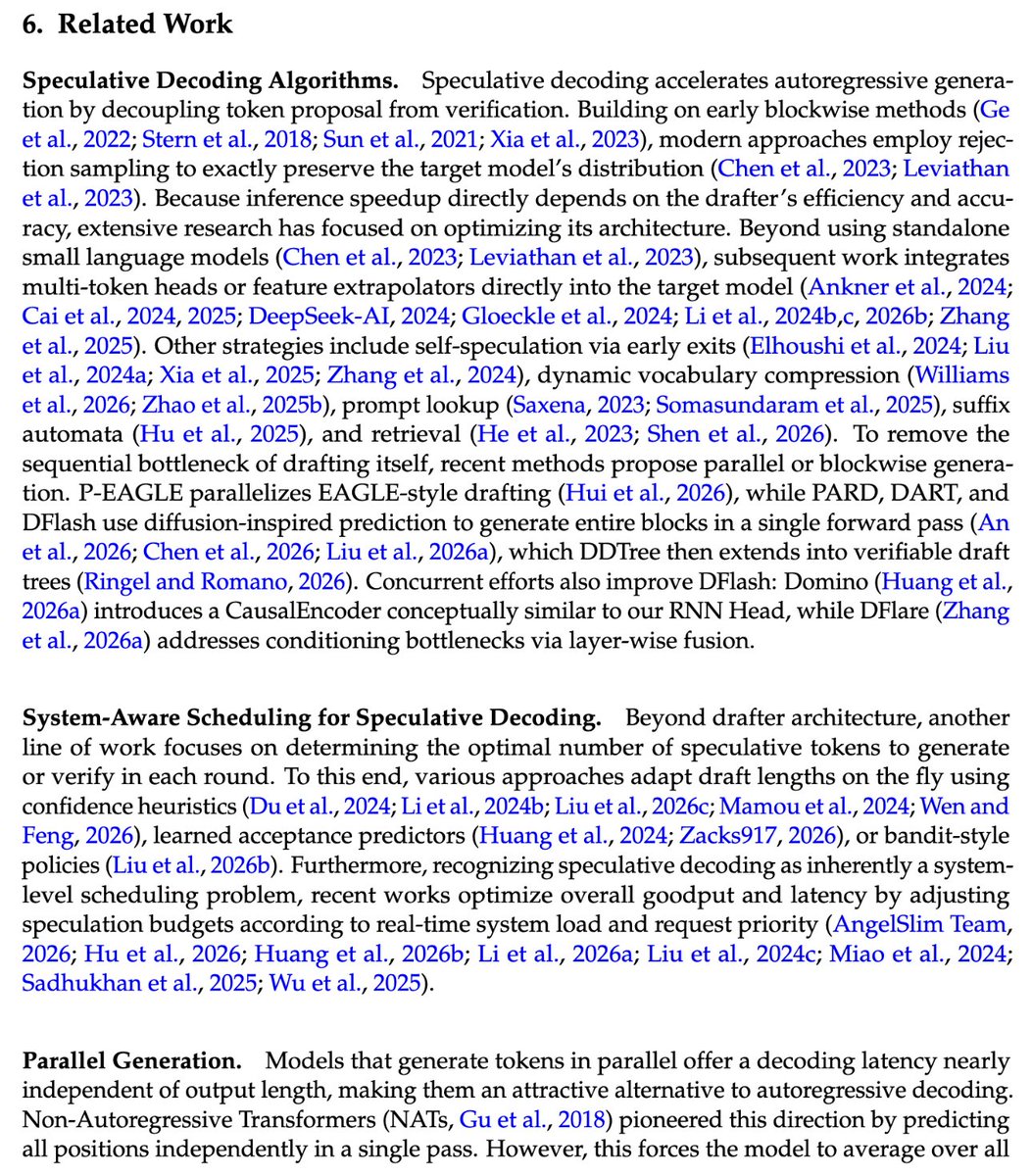
- Released as a full paper (33 authors from Peking University & DeepSeek-AI, led by Xin Cheng et al., with Wenfeng Liang as senior author) plus the open DeepSpec training repo and public checkpoints (
deepseek-ai/dspark_qwen3_4b_block7, etc.).
The enthusiasm wasn't confined to DeepSeek's research org. Tianyi Cui (崔添翼) — the former Jane Street quant who joined DeepSeek in March 2026 to lead its Harness team building DeepSeek's agent stack — spotlighted the open-source DeepSpec repo and DSpark on Weibo. It's a small but telling signal of how broadly the company is leaning on speculative decoding — not just to serve V4 cheaply, but as table-stakes infrastructure for the latency-sensitive agent products the Harness team is racing to ship. And the adoption didn't stop at DeepSeek's own walls: a month later, optimized DSpark drafters turned up as the single largest slice of Intent Lab's autonomous 6.3× TensorRT-LLM speedup (see the adoption ledger below).
DSpark in Ten Ideas — Dmytro's thread, walked through
Dmytro Dzhulgakov (Fireworks AI) explained DSpark as a "10 ideas" thread that builds up from the very basics of LLM decoding to the full DSpark design. Here is that thread walked through step by step, each with its original diagram. Every card links back to the source tweet.
DSpark from @deepseek_ai ingeniously integrates many speculative decoding ideas to achieve 1.5x to 5x higher throughput in a real production system. Let's understand it with 10 ideas, starting from the very basics 🧵
Batching in LLM decoding
Generating tokens is bound on reading weights from memory. So decoding 10 tokens in parallel is only slightly slower than generating 1. Continuous batching leverages this insight.
Speculative decoding
For the same request, token N+1 depends on token N, so we can't decode them in parallel. But if we can guess what the tokens are ("speculate"), we can quickly verify which prefix of them is correct from the main model perspective.
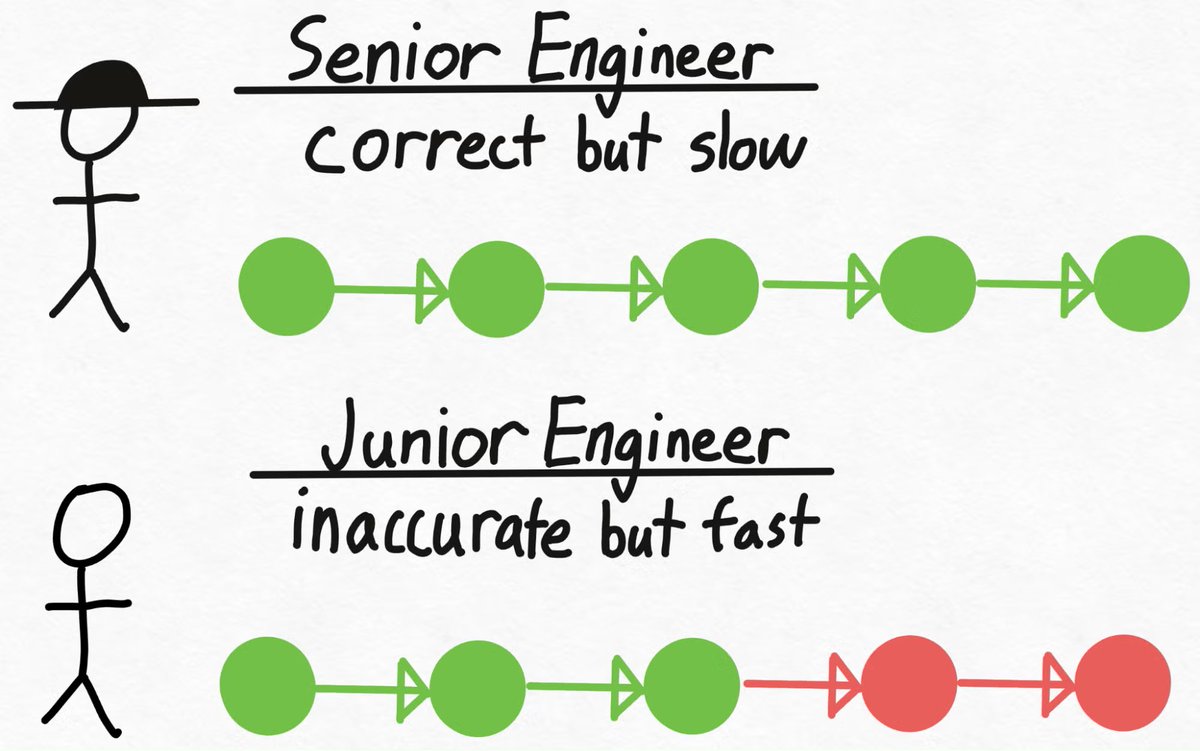
Draft model
How to speculate? With a model, of course. The simplest is to run a smaller model trained on the same distribution, e.g. Qwen 0.8B for Qwen 397B.
Speculation is not free
time_per_token = (num_tokens_drafted * drafter_time + verify_time(num_tokens_drafted)) / num_tokens_accepted
Slow to run speculator or drafting too many tokens with a low guess rate can be hurtful. The right balance is needed.
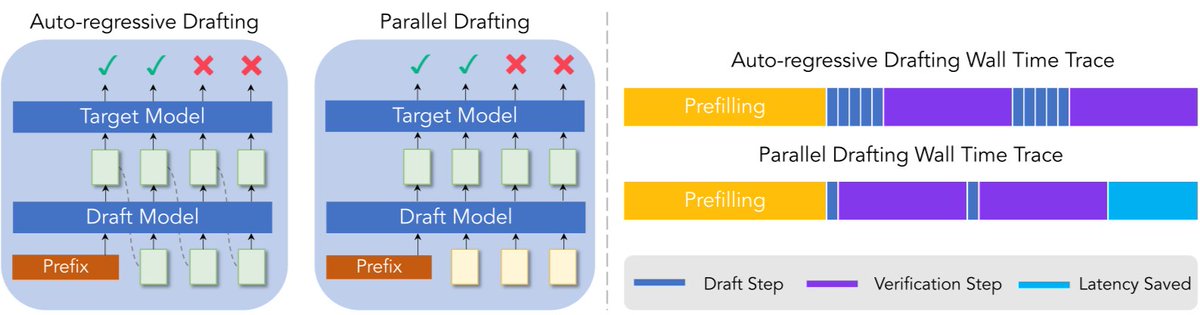
EAGLE and MTP
Make drafter an extra transformer layer of the main model, i.e. it consumes rich latent representation (last activation) in addition to the previous token. Allows to get away with 1-2 layers instead of the full model. Much faster and more accurate speculator.
DFlash
MTP needs to take N steps to generate N draft tokens. DFlash uses diffusion ideas to produce all N tokens in one forward pass. Much faster speculation, but draft quality sometimes better, sometimes worse than MTP/Eagle.
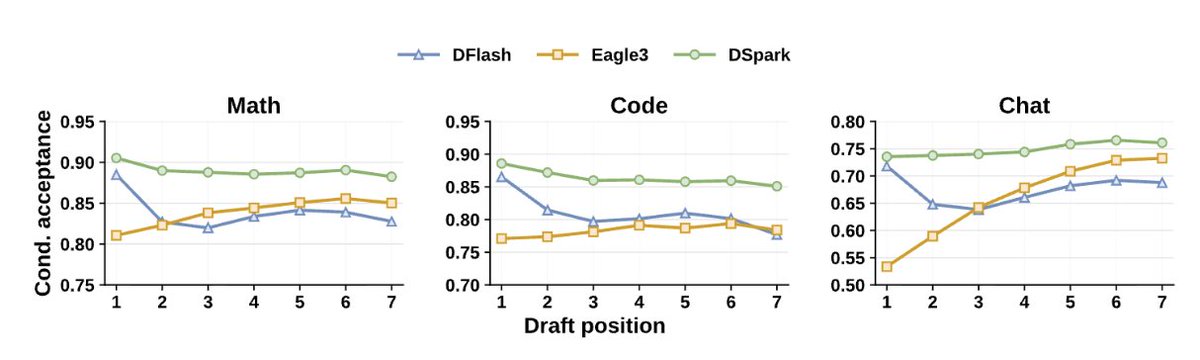
DSpark ≈ EAGLE + MTP
DFlash is stronger at initial positions. Eagle3 is more coherent on long drafting but has lower quality guess in the beginning. DSpark combines both parallel block and autoregressive ideas, beating either approach.
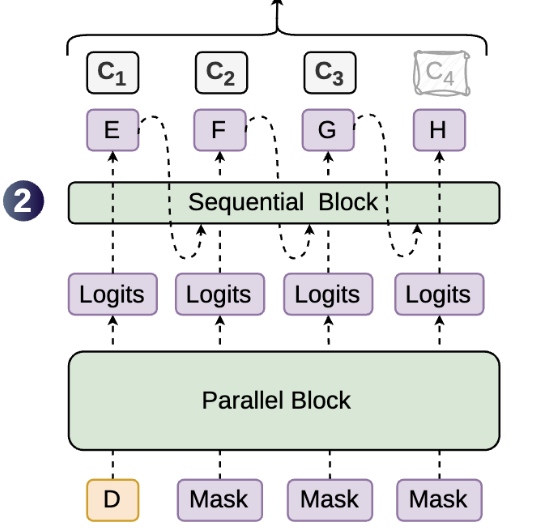
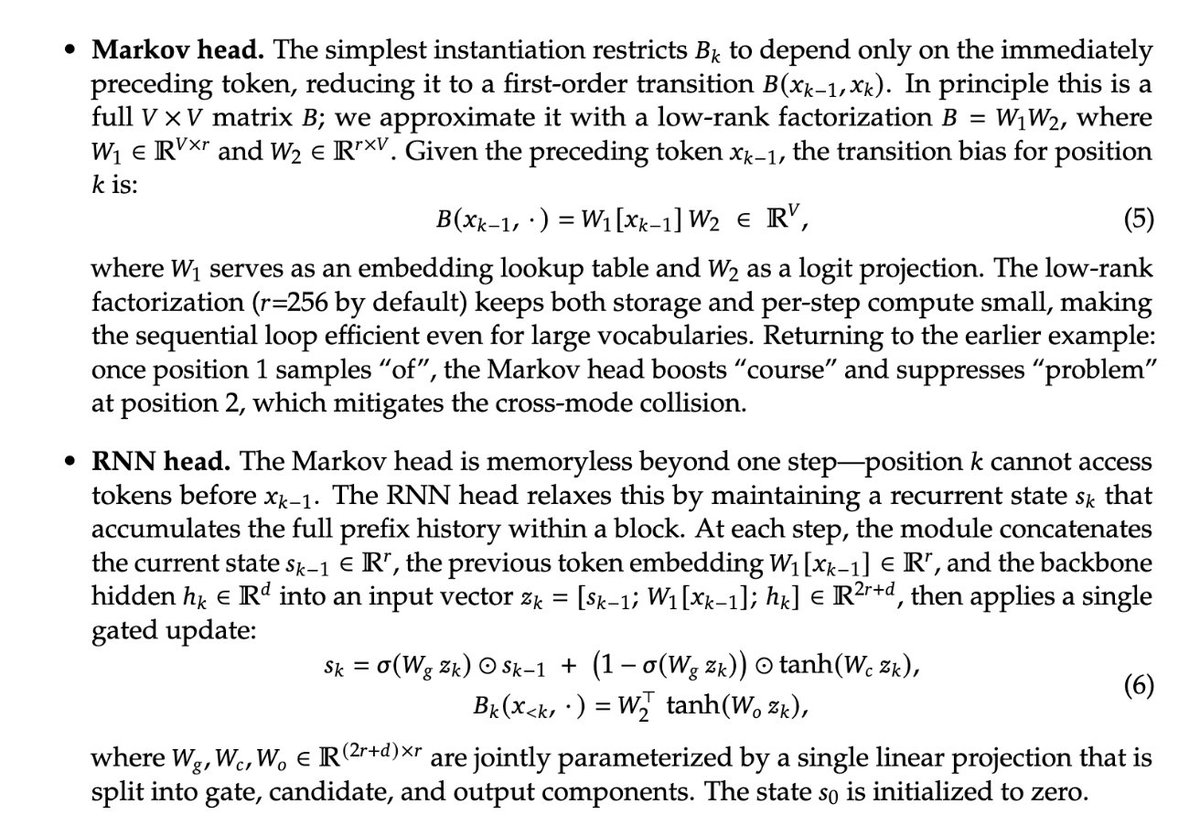
Cheaper sequential block
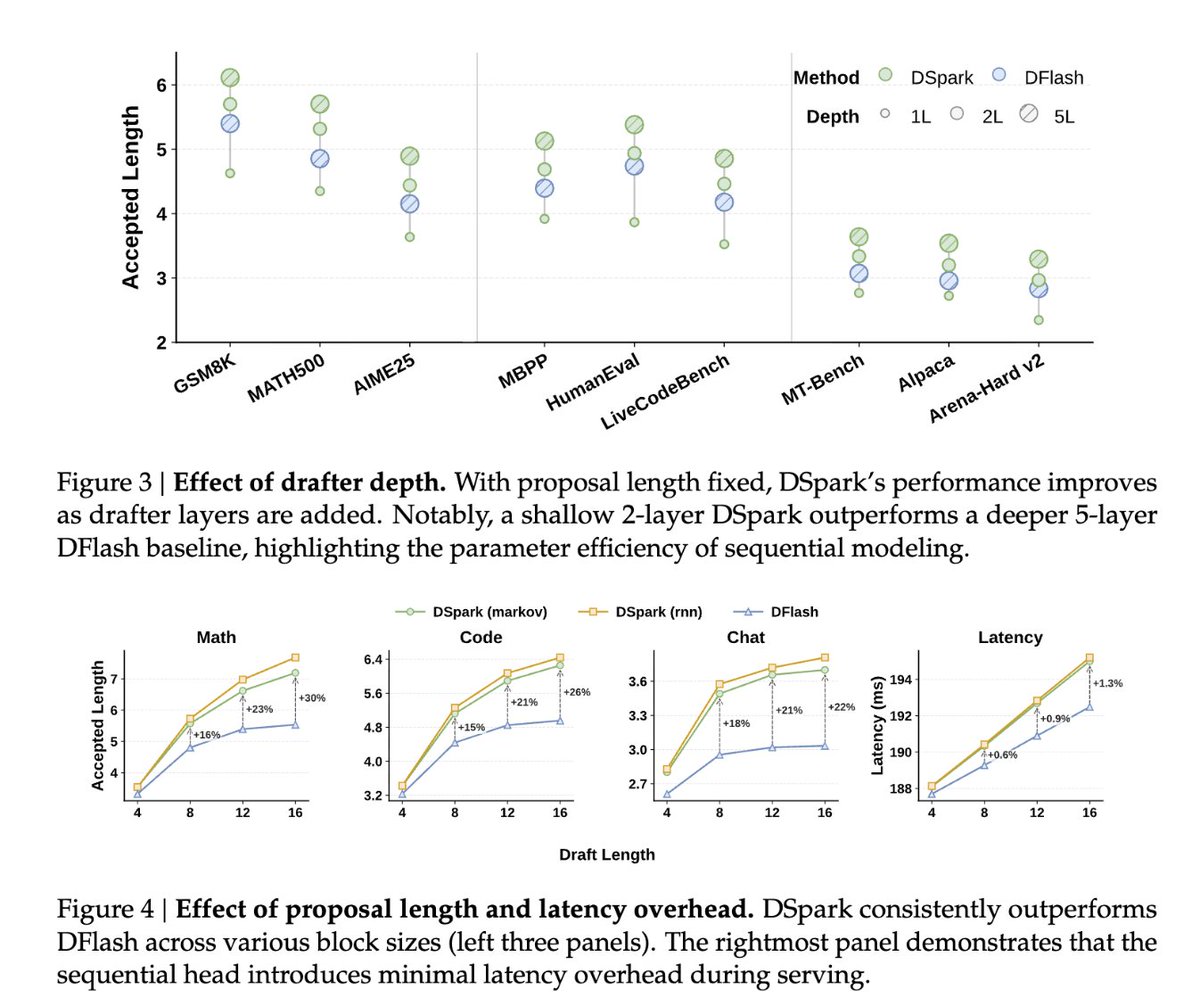
Eagle3/MTP run full attention at each drafting position. Since DFlash has parallel block to capture previous context, sequential step can be much cheaper with RNN or even Markov model. All leads to an even faster but still accurate drafter!
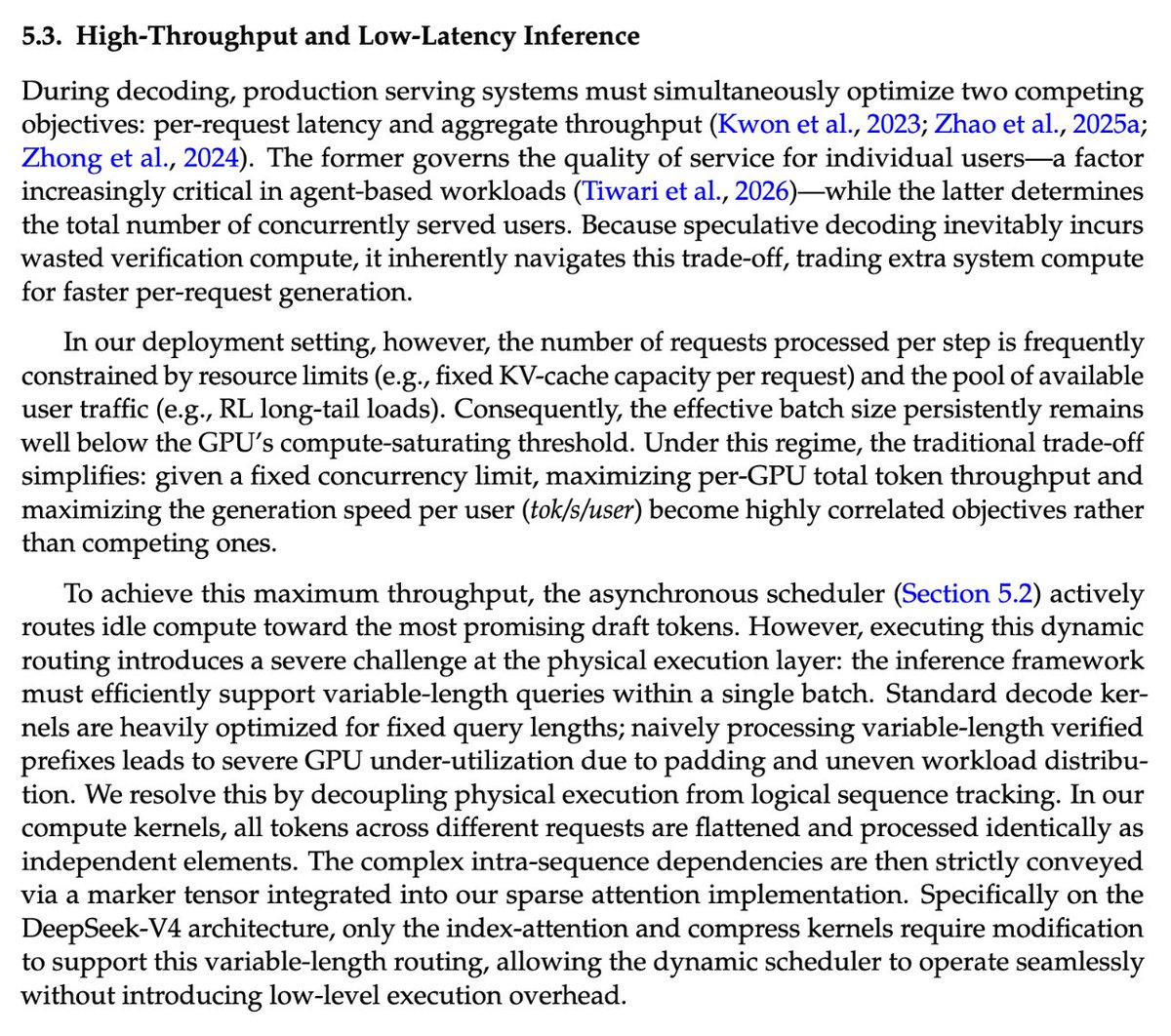
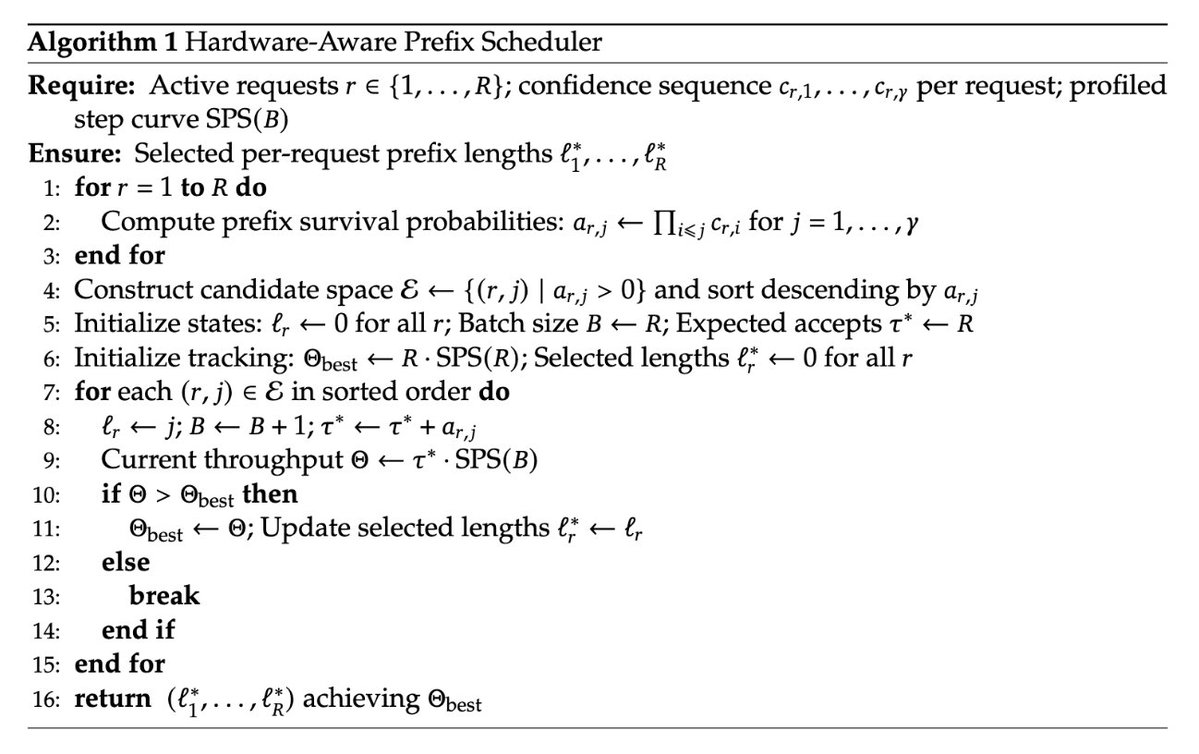
Variable length drafting and hardware-aware scheduler
What num_draft_tokens should be? It varies: * some requests (e.g. coding) are easier to predict than others * optimal length depends on server load (batch size). Speculate more with low load when GPU compute is free.
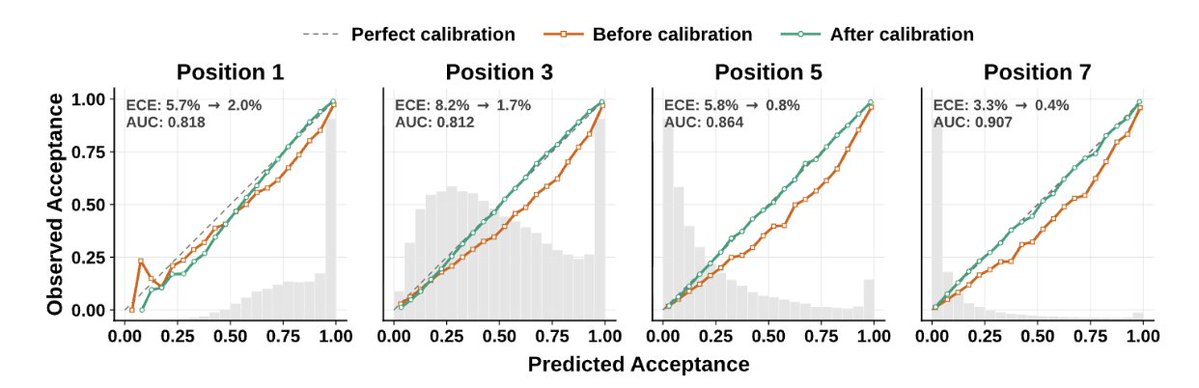
Online drafter calibration
Models tend to be overconfident in predicting the next token making it hard to get threshold for stopping drafting. But we can look at the runtime drafter performance and adjust ("calibrate") thresholds on the fly.
Putting it together
The magic of DeepSeek is in excellent system engineering with close model co-design. Many of these ideas were published before. It's very impressive how they integrate them together to deliver huge e2e improvements with auto-adapting system.
Gemma 4 Assistant — speculative decoding for everyone
Gemma 4 is where this trend went open. Alongside the main lineup, Google announced a companion line of autoregressive drafter models plus an MTP head — officially branded the "Gemma 4 Assistant" and published as the -assistant checkpoints (e.g. google/gemma-4-E4B-it-assistant; the Transformers model type is gemma4_assistant, loaded as the assistant_model). Under the same Apache-2.0 license, it delivers up to 3× faster inference "with zero degradation in output quality or reasoning accuracy." Crucially, it shipped with day-one support across Transformers, MLX, vLLM, SGLang, and Ollama, so the speedup was usable immediately rather than a research artifact.
Per the official docs, Gemma 4's MTP is more than a bolt-on drafter. Three enhancements make the draft tokens cheaper and more accurate:
- Shared input embeddings. The draft model reuses the target's embedding table rather than carrying its own.
- Target activations. The drafter takes the target's last-layer activations, concatenates them with token embeddings, and down-projects to the drafter's dimension — so it isn't blind to the backbone's state.
- Efficient embedder. To avoid scoring the whole vocabulary, tokens are grouped into clusters; the head first picks likely clusters, then restricts final calculations to those (E2B/E4B variants).
One honest caveat from the docs: for the MoE model (Gemma 4 26B A4B), verifying drafted tokens can require loading additional expert weights, which can offset the gains at batch size 1 on hardware without good parallelism. Higher batch sizes recover the win as expert activations overlap. This Gemma 4 release is the direct ancestor of the Gemini Nano work that follows — Google's own blog notes the frozen-MTP effort builds on "accelerating Gemma 4 with MTP."
Gemini Nano Frozen MTP — June 26: the same idea, at the edge
Seven weeks after the Gemma 4 launch, Google Research took the same idea to the far end of the deployment spectrum: not a datacenter, but a phone. Mobile inference lives under hard RAM and energy budgets, and a standard speculative-decoding setup wants a separate drafter model (e.g. 128M params) that competes for memory and is "blind" to the main model's internal state. Their answer, detailed on the Google Research blog, is to retrofit Multi-Token Prediction onto a frozen Gemini Nano v3 — already deployed on Pixel 9 and 10.
The design rests on three moves:
- Late-exit MTP head. Instead of a standalone drafter, a lightweight Transformer head is appended to the final layers of the main model and predicts future tokens from the backbone's high-dimensional hidden states.
- Frozen backbone. The base model's weights are frozen; only the head is trained. This guarantees zero degradation in capability or safety alignment, and lets efficiency updates roll out with full backward compatibility — output stays bit-for-bit identical.
- Zero-copy architecture. The head cross-attends directly to the main model's frozen KV cache instead of maintaining its own. This eliminates drafter prefill latency and saves ~130 MB per instance versus a standalone drafter.
In production workloads like AI Notification Summaries and Proofread, MTP correctly predicts nearly two additional tokens per pass, yielding 50%+ speedups on Pixel 9 and up to 55% better token acceptance on highly structured tasks (e.g. smart replies) — while cutting energy use by waking heavy processors less often. The work explicitly builds on the EAGLE framework and CALM (Confident Adaptive Language Modeling), and points ahead to branching/parallel decoding and "verification leniency."
Comparison — three angles on one idea
| Dimension | Gemma 4 Assistant | Gemini Nano Frozen MTP | DeepSeek DSpark |
|---|---|---|---|
| Announced | May 5, 2026 | June 26, 2026 | June 27, 2026 |
| Target setting | Open-weights, general / on-device | On-device (Pixel 9 & 10) | Server-scale production serving |
| Base model | Gemma 4 family (incl. 26B A4B MoE) | Gemini Nano v3 | DeepSeek-V4 (Flash & Pro) |
| Open source? | ✔ Yes — Apache-2.0 weights (HF, Kaggle) | ✗ No — proprietary; ships inside Pixel updates | ✔ Yes — MIT: paper + code + checkpoints via the DeepSpec repo |
| Drafter design | Autoregressive drafter + MTP head; shared embeddings, target activations, clustered embedder | "Late-exit" MTP head on frozen backbone; cross-attends to main KV cache (zero-copy) | Built on V4's MTP-1 head + "semi-parallel" candidate generation |
| EAGLE-based? | ~ Partial — EAGLE-style feature conditioning (consumes the target's last-layer activations), but an MTP "assistant" head rather than the EAGLE algorithm itself | ✔ Yes — explicitly builds on the EAGLE framework (plus CALM late-exit) | ✔ Yes — an EAGLE-3 + MTP hybrid ("DSpark ≈ EAGLE + MTP") |
| Parallel drafting? | ✗ No — the assistant drafts autoregressively (one token at a time) | ✗ No — autoregressive MTP head (parallel/branching decoding is stated future work) | ✔ Yes — hybrid: DFlash parallel block (all N tokens in one pass) + an autoregressive EAGLE-style step |
| Uses DFlash (block-diffusion drafter)? | ✗ No — autoregressive MTP "assistant" head, no diffusion | ✗ No — autoregressive late-exit MTP head, no diffusion | ✔ Yes — the DFlash block-diffusion drafter is the parallel half of DSpark (paired with an autoregressive EAGLE-3/MTP step) |
| Integrated, or separate drafter model? | ~ Separate companion — a small "assistant" checkpoint loaded alongside, but it shares the target's embeddings & activations | ✔ Integrated — a late-exit head on the frozen backbone; no standalone model, near-zero extra footprint (zero-copy) | ✔ Integrated — MTP-1 head + DFlash block ride the deployed V4 weights; no separate standalone LM |
| Shares target KV cache? | ~ Partial — shares input embeddings & consumes target activations, but not full KV-cache cross-attention | ✔ Yes — zero-copy cross-attention directly to the frozen KV cache (no own cache; ~130 MB saved) | ✔ Yes — integrated MTP head rides the model's own trunk/KV (no separate drafter cache) |
| Verification | Standard parallel verify (lossless) | Standard parallel verify; bit-for-bit identical | Adaptive / confidence-scheduled verification |
| Backbone training | MTP heads pre-trained in tandem with backbone | Frozen backbone; only head trained (retrofit) | No base retraining; optimization over deployed weights |
| Headline speedup | Up to 3× inference | 50%+ on Pixel 9; ~2 extra tokens/pass | 1.5×–5× throughput; 57–85% per-user |
| Quality impact | Lossless | Lossless (frozen backbone) | Lossless (drafts discarded on reject) |
| Headline win | Ecosystem reach + day-1 framework support | ~130 MB memory saved; lower energy / battery | Real-traffic throughput; no waste on bad checks |
| License / access | Open, Apache 2.0 (HF, Kaggle) | Proprietary, shipped in Pixel updates | Open checkpoint on Hugging Face + paper |
The throughline: all three keep output lossless, all three move away from standalone drafters toward heads that reuse the backbone's own state (embeddings, activations, or KV cache), and all three are converging on the same next frontier — branching drafts and relaxed verification. The difference is purely environmental: Gemma 4 optimizes for reach, Gemini Nano for memory and energy, and DSpark for throughput under load.
Seen in Production — a running ledger of adoption
The real test of any inference technique is production traffic. The deployments below shipped with the speculators covered above — each entry records what ran, where it ran, and the numbers reported, newest first.
In "Turn your intent into production systems", Intent Lab's agent fleet re-engineered TensorRT-LLM to run GLM 5.2 on Grace Blackwell nodes — end to end, with no human intervention. Of the four optimization categories behind the overall 6.3× speedup (+534%), speculative decoding is by far the largest slice: ×4.0 on its own — "combining optimized DSpark drafters to propose multiple tokens per step and verify them in one pass, the engine reaches a 647 tok/s speed." Kernel (+24%), runtime (+16%), and communication (+18%) work compound the rest. Notably, when an autonomous system went hunting for inference speed, it reached for the same drafter DeepSeek ships.
Redrawn from Intent Lab's "Breakdown of performance gains" chart — speculative decoding dwarfs every other category combined.
Modal serves Thinking Machines' Inkling backed by a custom-trained DFlash speculator on Modal Auto Endpoints with SGLang — the block-diffusion drafter from the glossary, in production on day one of a frontier release. Soumith Chintala: "Modal trained a DFlash speculator that's much faster than MTP, making it a great boost for inference speeds!"
Papers — the lineage behind the wave
The 2026 releases stand on a well-defined chain of research. The foundational and directly-cited papers, grouped by theme:
1 · Foundations
The paper that named speculative decoding: decode K tokens with a cheap drafter, verify in parallel with the target, and accept the correct prefix — faster, with no change to the output distribution.
The contemporaneous speculative-sampling formulation, with the rejection-sampling correctness proof that guarantees the accelerated output matches the target model's distribution.
The MTP training objective — predict several future tokens at once with extra heads. Cited by both Google docs as the "standard MTP implementation" the 2026 drafters build on.
The "late-exit"/early-exit lineage the Gemini Nano work draws on: dynamically allocate less compute to easy tokens. Foundation for the late-exit MTP head on a frozen backbone.
2 · EAGLE family
Drafts at the feature level: the drafter is an extra layer that consumes the target's last activation plus the previous token, making guesses that the target is far more likely to accept.
Adds context-aware dynamic draft trees, expanding the most promising draft branches. 3.05–4.26× speedups, 20–40% over EAGLE-1, still lossless.
Abandons feature prediction for direct token prediction and fuses multi-layer features via a "training-time test", so the drafter keeps improving with more training data. Up to 6.5× speedup (~1.4× over EAGLE-2); the variant DSpark's author compares against for long drafting.
An incremental refinement of EAGLE-3: adds FC normalization after each target hidden state and feeds the post-norm hidden states into the next decoding step. This fixes two instabilities at deeper speculation depths — the fused input getting dominated by higher-layer hidden states, and hidden-state magnitude growing along the unnormalized residual path — making the drafter stable for longer drafts.
Transforms EAGLE from autoregressive into parallel multi-token prediction via a learnable shared hidden state, removing the serial K-passes bottleneck while keeping feature-grounded accuracy. Checkpoints under amazon/…-p-eagle.
3 · Parallel & diffusion drafting
Replaces the autoregressive drafter with a lightweight block-diffusion model that produces a whole K-token block in a single forward pass (O(K)→O(1) drafting), conditioned on the target's hidden features for accuracy. Drafting latency becomes nearly free, shifting the bottleneck to draft quality. It is the "parallel block" half of DeepSeek's DSpark; deployed in vLLM & vLLM-TPU.
4 · DeepSeek & DSpark
The source of DeepSeek's built-in MTP design (shared embedding/output head for MTP) that the V4 line inherits and DSpark accelerates.
The framework itself. A semi-autoregressive drafter — a parallel backbone coupled with a lightweight sequential module — adds intra-block dependency to fix the acceptance decay that pure parallel drafters suffer, while confidence-scheduled, load-aware verification tailors the verification length per request from estimated prefix-survival probabilities and engine throughput. In the DeepSeek-V4 serving system under live traffic it beats the MTP-1 production baseline by 60–85% per-user at matched throughput. Open-sourced with the DeepSpec training repo (which also ships DeepSeek's own DFlash & EAGLE-3 drafters).
5 · MTP for speculative decoding
Aligns MTP training with its inference pattern to improve multi-step draft quality. ~2.03× speedup with lossless output, outperforming vanilla MTP by 82%. Weights at TencentBAC/FastMTP.
6 · Retrospective
Google Research's own retrospective on the technique, linked directly from the Gemini Nano frozen-MTP post.
Model checkpoints. The systems above are not just papers — they ship weights you can run: DSpark on DeepSeek-V4-Flash (deepseek-ai/DeepSeek-V4-Flash-DSpark), the open Gemma 4 Assistant MTP drafters (google/gemma-4-E4B-it-assistant), and the EAGLE/EAGLE-3 drafter checkpoints used across vLLM and SGLang. DSpark's thread author and explainer is Dmytro Dzhulgakov (@dzhulgakov), co-founder & CTO of Fireworks AI and a longtime PyTorch core maintainer.
Where the Drafters Come From — the open-source training libraries
Every system above ships a trained drafter — an EAGLE head, an MTP head, a DFlash block. But who trains them, and on what infrastructure? The quieter half of the 2026 story is the rise of dedicated open-source training libraries that turn drafting from a research artifact into a repeatable pipeline. They all wrestle with the same core obstacle — funneling the target model's hidden states into the draft model cheaply, at scale — and each attacks it from a different angle. DeepSpec, the repo behind DSpark above, and Tencent's brand-new AngelSpec are the latest entries in a line that runs back through 2025 — the Speculator Trainers rail at the top of this post traces the full one-year lineage, July 2025 to July 2026. Here is each library in detail:
The libraries, in detail
A purpose-built, EAGLE-3-focused training framework tightly integrated with SGLang, so a freshly trained draft head runs out of the box at inference. Provides built-in Training-Time Test (TTT) support, both online (hidden states on the fly) and offline (precomputed) modes, FSDP + tensor parallelism for large clusters, and native support for MoE targets like Llama 4 and DeepSeek.
A unified library for building, training, and storing drafters in a single standardized Hugging Face format with immediate vLLM compatibility — so a speculator trained anywhere drops straight into a production server. Training landed in v0.3.0; v0.5.0 (May 2026) added DFlash support and fully unified online training on vLLM's native hidden-state extraction.
A managed path in the SageMaker AI inference-optimization toolkit that trains EAGLE-2/3 heads, and crucially retrains them on your own captured traffic, so the drafter adapts to your real workload rather than a generic benchmark. Supports six architectures (Llama, Qwen2/3, Qwen3-MoE, GPT-OSS with EAGLE-3; Qwen3-Next with EAGLE-2) and ships pre-trained heads for instant use. (Disclosure: a project I had a hand in shipping on the SageMaker AI team.)
A torch-native framework for disaggregated drafter training that solves the hidden-state bottleneck head-on: it splits the inference GPUs that generate target hidden states from the training GPUs that consume them, streaming tensors directly over RDMA/TCP via the Mooncake store — eliminating both the multi-TB disk cost of offline pipelines and the memory pressure of co-located training. Scales inference and training independently; supports vLLM & SGLang targets.
The training repository DeepSeek open-sourced together with the DSpark paper. Beyond the DSpark recipe itself, it ships training for DeepSeek's own DFlash block-diffusion and EAGLE-3 drafters — the production-side counterpart to the algorithm research earlier in this post, and the library that anchors the 2026 end of the Speculator Trainers rail at the top.
An end-to-end speculative decoding framework that covers both training and deployment in one stack — the first entry in this list to treat the two as a single pipeline rather than a handoff. Torch-native training for MTP and block-parallel drafters, shipped together with MTP and DFly drafter weights for Hy3-A21B, so the reported numbers are reproducible on day one. On Hy3-A21B, DFly delivers 1.98–2.40× end-to-end speedup over autoregressive decoding across concurrency levels from 4 to 64, with 10.5–11.8% higher throughput than DFlash — a direct, like-for-like comparison against DeepSeek's block-diffusion drafter discussed earlier in this post.
Two months, two labs, three releases, one converging idea — and beneath them, six open-source training stacks (from SGLang, vLLM/Red Hat, AWS, PyTorch×Mooncake, DeepSeek, and Tencent Hunyuan) turning those drafters into a reproducible pipeline. If 2024–2025 was about training bigger and cheaper models, 2026 is shaping up to be the year speculative decoding became the standard way to serve them — on a phone, in a datacenter, and everywhere in between.
"最快的 token,是你永远不必生成第二次的那个。"
— 每一套投机解码(speculative decoding)系统的核心思想
投机解码已经悄然成为让大语言模型变快的默认方式。原理很简单:一个小而便宜的草稿模型(drafter)一次性向前猜测若干个 token,大的目标模型(target)在一次并行前向中验证它们 —— 同意的就采纳,遇到第一个不同意的就纠正。由于被拒绝的草稿会被丢弃,输出与普通自回归解码逐比特完全一致。这是纯粹的效率收益,而非质量的取舍。
在我自己关于 LLM 领域的写作中——从 LLM 年度回顾 到 MLSys 2026 回顾——我看着这项技术从一个巧妙的小技巧变成了生产环境的刚需。2026 年引人注目之处,在于整个领域在短短两个月内、从三个截然不同的角度收敛到了同一个答案:DeepSeek 服务器规模的 DSpark、谷歌开源的 Gemma 4 Assistant,以及谷歌端侧的 Gemini Nano 冻结式 Multi-Token Prediction。本文沿着时间线梳理,逐一总结,把它们并排对比 —— 并持续记录它们在生产环境中的落地。
2026 浪潮一览
两条时间轴,一个故事 —— 都按从最新到最早排列。先看投机器发布:三次发布,八周时间,一个思想 —— 从把投机解码送到所有人手中的开源草稿模型,到端侧,再到超大规模服务。再看投机器训练器(speculator trainer):让这些草稿器可复现的开源训练库,一条恰好一年的脉络 —— 2025 年 7 月到 2026 年 7 月(每个库的详细介绍见下文)。
投机器发布 — 三次发布,八周时间 · 最新在前
Intent Lab 的 Agent 舰队为 GLM 5.2 重构 TensorRT-LLM(Grace Blackwell 节点)—— 端到端 6.3×,其中投机解码是最大的一块(×4.0),由优化过的 DSpark 草稿器驱动,达到 647 tok/s。完整拆解见落地台账。
DFlash 在前沿模型发布首日即投入生产:Modal 上线 Thinking Machines 的 Inkling,由定制训练的 DFlash 投机器加持——在 Modal Auto Endpoints 上搭配 SGLang,吞吐与交互性提升 67%。Soumith Chintala:"Modal 训练的 DFlash 投机器比 MTP 快得多,是推理速度的一大助力!"
DeepSeek 在 DeepSeek-V4 自带的 MTP-1 之上,叠加了一套"半并行(semi-parallel)"投机框架与置信度调度的验证。在真实生产流量中,单用户提速 57–85%,吞吐提升 1.5×–5×。
谷歌研究院把 MTP 改造性地装到冻结的 Gemini Nano v3 上(Pixel 9/10)。一个"晚退出(late-exit)"头通过交叉注意力直接读取主模型的 KV cache(零拷贝),节省约 130 MB,并带来 50%+ 的提速,每次前向平均多接受约 2 个 token。
谷歌发布了一系列自回归草稿模型 —— 官方称为 "Gemma 4 Assistant"(即 -assistant 检查点)—— 外加为 Gemma 4 家族准备的 MTP 头。推理最高提速 3×、无损、Apache-2.0,并自首日起支持 Transformers、MLX、vLLM、SGLang 与 Ollama。
2026 年投机解码浪潮(最新在前)—— 三次发布,以及随之而来的生产落地。
投机器训练器 — 恰好一年:2025 年 7 月 – 2026 年 7 月 · 最新在前
一个端到端框架,同时覆盖训练与部署 —— torch 原生地训练 MTP 与块并行草稿器,并随发布提供 Hy3-A21B 的 DFly 草稿器权重。在并发 4–64 区间取得 1.98–2.40× 的端到端加速,吞吐比 DFlash 高 10.5–11.8%。X 上的发布公告。
DeepSeek 随 DSpark 一起开源的仓库 —— 不仅给出 DSpark 配方,还附带 DeepSeek 自训的 DFlash 与 EAGLE-3 草稿器训练,把算法研究与可运行的生产栈闭环起来。
一个 torch 原生的解耦式(disaggregated)草稿器训练框架:把生成隐藏状态的推理引擎与消费隐藏状态的训练 worker 解耦,通过 Mooncake 存储以 RDMA/TCP 直接流式传输张量 —— 不落盘,也不共置。约 1,500 H200 小时训出一个 Kimi K2.5 的 EAGLE-3 草稿器。
同一个月里的两记生产化重拳。Speculators(vLLM / Red Hat)把草稿器标准化为统一的 Hugging Face 格式,开箱即在 vLLM 中运行;亚马逊 SageMaker AI 推出 EAGLE-2/3 自适应投机解码,在你自己的流量上重训草稿头,带来约 2.5× 的吞吐。
首个专为 EAGLE-3 打造的训练框架,与 SGLang 原生打通 —— 草稿模型一训完即可部署。内置训练期测试(TTT)、在线与离线两种隐藏状态模式、FSDP + 张量并行,并原生支持 MoE 目标(Llama 4、DeepSeek)。
一年的训练库发布(最新在前)—— 让投机解码从一篇论文变成一条流水线的工具。
用大白话讲关键术语 — EAGLE、MTP、DFlash
这几个名字在这些公告里到处出现。下面用所链接来源的内容,简单解释每一个:
| EAGLE | MTP (Multi-Token Prediction) | DFlash (块扩散草稿器) | |
|---|---|---|---|
| 一句话 | 一种更聪明的起草方式(一个以目标特征为条件的微型额外层)。 | 让一个模型一次说出好几个词(额外预测头)。 | 用扩散一次性起草一整块 token。 |
| 大白话 | 普通草稿模型只根据已有的词来猜下一个词。EAGLE 则提前一步预测大模型内部的"思维向量"(隐藏特征),并基于此来起草,于是更多猜测被接受 —— 接受越多,速度越快。 | 通常模型写一个 token、回填、再写下一个 —— 串行而慢。MTP 加装轻量的额外"头",预测接下来的 2–4 个 token,搭便车复用模型自身的嵌入/激活。大模型并行验证、只保留正确的,因此质量不变。 | DFlash 不再一次猜一个 token,而是用块扩散模型在一次前向中"绘制"出全部 N 个草稿 token,同时仍以目标隐藏特征为条件保证质量。起草延迟几乎降为零,瓶颈转移到草稿质量。 |
| 起草方式 | 自回归 | 自回归 | 并行(非自回归) |
| K 个 token 的前向次数 | K 次串行 | K 次串行 | 1 次 —— O(1) |
| 条件来源 | 目标最后一层特征 + 上一个 token(EAGLE-3:多层融合) | 共享目标的主干与嵌入 | 目标隐藏特征(目标条件),块内双向 |
| 如何训练 | 在目标隐藏状态上训练一个 1–2 层草稿头(便宜) | MTP 头与骨干一起 / 在骨干之上训练,预测接下来的 k 个 token | 训练一个轻量块扩散草稿器,以目标特征为条件,对一块 K 个 token 去噪 |
| 独立草稿模型,还是无草稿模型? | ~ 小草稿头 —— 搭在目标上的 1–2 层额外训练层(并非完整独立模型) | 无草稿模型 / 集成 —— 额外的头直接做进目标模型本身;无需另外加载模型 | 独立草稿器 —— 一个轻量块扩散模型,按每个目标训练并随附 |
| 优势 | 接受率高;长草稿连贯 | 便宜、集成;搭乘模型自身的计算 | 起草延迟≈零;块开头强;大加速器上更宽的块≈免费 |
| 劣势 | 串行:延迟随深度增长 | 串行:K 个 token 要 K 次前向 | 块尾质量可能下降;需为每个目标训练扩散草稿器 |
| 出处 | Gemini Nano "构建于其上"的基础。家族:EAGLE-2(草稿树)、EAGLE-3(训练期测试)、EAGLE-3.1、P-EAGLE。arXiv:2401.15077。 | 三次发布共同的思想:Gemma 4 内置 MTP 头;Gemini Nano 装到冻结模型上;DeepSeek-V4 原生内置(见下方 MTP-1)。Gemma 文档 · arXiv:2404.19737。 | UCSD Z-Lab,ICML 2026(arXiv:2602.06036);DeepSeek DSpark 中"并行块"的那一半。不同于 DeepSeek-V4-Flash 模型。 |
所以清晰的心智模型是:EAGLE 与 MTP 都是自回归草稿器(区别在草稿器住在哪里 —— 一个以特征为条件的额外层 vs. 额外的头),而 DFlash 是异类:它是并行的,靠扩散一次性生成整块。串行 vs. 一次前向 —— 这正是本文其余部分围绕的那条轴。
附加术语 —— MTP-1: 就是"只带一个额外头的 MTP",即向前预测一个 token。DeepSeek-V4 内置了 MTP-1(每次前向 2 个 token);DSpark 随后在这个基线之上叠加其半并行、置信度调度的验证。
是什么: DFlash("Block Diffusion for Flash Speculative Decoding",UCSD Z-Lab —— Jian Chen、Yesheng Liang、Zhijian Liu;ICML 2026)用一个轻量块扩散模型替代自回归草稿器。它不再一次猜一个 token,而是在一次前向中"绘制"出一块 K 个候选 token —— 把 O(K) 的串行起草变为 O(1)。
怎么训练: 训练一个小的块扩散草稿器,去噪/生成一块未来 token,并以从目标模型抽取的上下文特征(隐藏状态)为条件 —— 正是让草稿保持准确的 EAGLE 式技巧。草稿器针对每个目标模型在指令数据上训练,并以检查点发布(如
z-lab/LLaMA3.1-8B-Instruct-DFlash-UltraChat、z-lab/Qwen3-4B-DFlash-b16),块大小 K 固定(如 10–16)。
怎么使用: 作为投机解码流水线里的提议器(proposer)直接接入;目标模型并行验证整块并保留正确前缀(无损)。它已集成进 vLLM(GPU/PyTorch)与 vLLM-TPU/JAX(PR #1868–1870),在多步之间维护一个目标隐藏状态的上下文缓冲。在 TPU v5p 上有"K 平坦(K-flat)"现象 —— 验证 16 个与 1024 个 token 代价几乎一样,因此更宽的块≈免费,真正的杠杆变成草稿质量。据报告:TPU v5p 上平均 3.13×(数学任务峰值≈6×);与 EAGLE-3 正面对比为 2.29× 对 1.30×。
在 DSpark 中: DeepSeek 的 DSpark 把 DFlash 的并行块(块开头强)与一个自回归的 EAGLE-3/MTP 步骤(长草稿深处连贯)融合,胜过任一单独方法。所以 DFlash 是一种通用、与模型无关的起草方法;DSpark 则是把它用作其两半之一的一个生产系统。
自回归解码 vs. 并行草稿 — 每种方法都落在这条轴上
三次发布之下都藏着同一组张力。草稿模型可以自回归地产出猜测(一次一个 token,每个猜测以上一个为条件),也可以并行草稿(一次预测一整块 token)。它们以相反的方式失效 —— 而 2026 年的这些系统,本质上是关于如何把两者结合的不同押注。
| 自回归草稿 | 并行草稿 | |
|---|---|---|
| 如何起草 | 串行地生成草稿 token —— 每个草稿 token 都要回填以产生下一个。 | 在一次前向中同时预测若干草稿 token(一个"并行块")。 |
| K 个草稿 token 的代价 | K 次串行草稿前向 —— 延迟随投机深度线性增长(一个"隐藏的架构天花板")。 | 整块只需一次前向 —— 深度几乎免费。 |
| 优势 | 后面的 token 能看到前面的猜测,长草稿更连贯("EAGLE-3 在长草稿上更连贯")。 | 在开头的位置非常强,因为草稿之间无需上下文("DFlash 在初始位置更强")。 |
| 劣势 | 草稿模型慢、或在低接受率下草稿过深,反而会拖累净速度。 | 靠后的草稿 token 看不到前面的,块越长质量越差。 |
| 代表 | EAGLE 家族(EAGLE-1/2/3/3.1)。 | MTP 头;P-EAGLE(并行草稿 EAGLE)。 |
这正是 P-EAGLE("并行草稿 EAGLE")要弥合的鸿沟:它通过一个可学习的共享隐藏状态,把 EAGLE 从自回归转变为并行多 token 预测,在保留 EAGLE 特征级准确性的同时去除串行前向瓶颈(arXiv:2602.01469;另见 vLLM 与 Amazon SageMaker AI 的文章)。
这也是为什么 DSpark 的作者 Dmytro Dzhulgakov(Fireworks AI 联合创始人兼 CTO,也是长期的 PyTorch 核心维护者)把 DSpark 描述为两种风格的融合:
"DSpark ≈ EAGLE + MTP。DFlash 在初始位置更强;EAGLE-3 在长草稿上更连贯,但开头的猜测质量较低。DSpark 结合了并行块与自回归两种思路,胜过任一单独方法。" —— @dzhulgakov
time_per_token = (num_tokens_drafted × drafter_time + verify_time(num_tokens_drafted)) / num_tokens_accepted
草稿模型太慢、或以低接受率草稿过多 token,都可能实际拖累吞吐。上面每个系统其实都只是在调这个分式的分子与分母。—— @dzhulgakov(Fireworks AI)
DeepSeek DSpark — 超大规模下的投机解码
DSpark 不是一个新模型 —— 它是叠加在既有 DeepSeek-V4 检查点之上的推理期优化。正如 Dmytro Dzhulgakov 在帖子里所说,它"巧妙地整合了许多投机解码思想,在真实生产系统中实现 1.5× 到 5× 的吞吐提升"。关键词是整合:DSpark 与其说是单一技巧,不如说是把业界最好的想法精心拼装、并为服务流量调优。
V4 本身已内置一个 MTP-1 头,所以在 DSpark 介入之前,基座模型每次前向就能产出两个 token。DSpark 在此之上加入 DeepSeek 所称的"半并行(semi-parallel)"方法:先投机生成多个候选 token,再施加自适应/置信度调度的验证 —— 只在有希望的猜测上花验证算力,而不是死板地逐个 token 检查。据报道其效果是消除了"无效检查带来的算力浪费"。
- 单用户速度: DeepSeek-V4 Flash 约提速 60–85%;Pro 版本约 57–78%(二手报道)。
- 吞吐: 视并发不同提升 1.5×–5×(帖子的主标题;报道援引 51%–400%)。
- 无需重训基座模型 —— 复用已部署的 V4 权重,因此收益本质上是在 MTP-1 之上的"免费"工程。
- 以完整论文发布(33 位作者,来自北京大学与 DeepSeek-AI,由 Xin Cheng 等领衔,梁文锋(Wenfeng Liang)为资深作者),并附开源的 DeepSpec 训练仓库与公开检查点(
deepseek-ai/dspark_qwen3_4b_block7等)。
热度并不止于 DeepSeek 的研究团队内部。崔添翼(Tianyi Cui) —— 这位前 Jane Street 量化工程师于 2026 年 3 月加入 DeepSeek,领衔打造其 Agent 技术栈的 Harness 团队 —— 也在 微博上推介了开源的 DeepSpec 仓库与 DSpark。这是一个细微却说明问题的信号:这家公司对投机解码的倚重之广 —— 不仅是为了低成本地服务 V4,更是把它当作 Harness 团队正全力推出的、对延迟敏感的 Agent 产品的基础设施。而且这波采用并未止步于 DeepSeek 自家院墙:一个月后,优化过的 DSpark 草稿器成为 Intent Lab 自主完成的 6.3× TensorRT-LLM 加速中最大的一块(见下文落地台账)。
用十个想法讲透 DSpark — Dmytro 长帖逐条走读
Dmytro Dzhulgakov(Fireworks AI)以一条 "10 个想法" 的长帖解释了 DSpark,从 LLM 解码的最基础概念一路搭建到完整的 DSpark 设计。下面逐步走读这条长帖,每条都附上原始示意图。每张卡片都链接回原推文。
来自 @deepseek_ai 的 DSpark 巧妙地整合了许多投机解码思想,在真实生产系统中实现 1.5x 到 5x 的吞吐提升。让我们用 10 个想法、从最基础处开始来理解它 🧵
LLM 解码中的批处理(Batching)
生成 token 受限于从显存读取权重。所以并行解码 10 个 token 只比生成 1 个略慢。连续批处理(continuous batching)正是利用了这一点。
投机解码
对同一请求,token N+1 依赖 token N,所以我们无法并行解码它们。但如果我们能猜出这些 token("投机"),就能从主模型的视角快速验证其中哪一段前缀是正确的。
草稿模型(Draft model)
如何投机?当然是用一个模型。最简单的是跑一个在相同分布上训练的更小模型,例如用 Qwen 0.8B 给 Qwen 397B 当草稿。
投机并非免费
time_per_token = (num_tokens_drafted * drafter_time + verify_time(num_tokens_drafted)) / num_tokens_accepted
投机器跑得慢、或在低命中率下草稿过多 token,都可能有害。需要恰到好处的平衡。
EAGLE 与 MTP
把草稿器做成主模型的一个额外 transformer 层,即除了上一个 token 之外,它还消费丰富的潜在表示(最后一层激活)。这样只需 1–2 层、而非整个模型,就能得到更快也更准确的投机器。
DFlash
MTP 需要 N 步来生成 N 个草稿 token。DFlash 借用扩散(diffusion)思想,在一次前向中产出全部 N 个 token。投机快得多,但草稿质量时好时坏,相比 MTP/EAGLE 各有胜负。
DSpark ≈ EAGLE + MTP
DFlash 在初始位置更强。EAGLE-3 在长草稿上更连贯,但开头的猜测质量较低。DSpark 结合了并行块与自回归两种思路,胜过任一单独方法。
更便宜的串行块
EAGLE-3/MTP 在每个草稿位置都跑完整注意力。由于 DFlash 有并行块来捕获之前的上下文,串行步骤可以用 RNN、甚至马尔可夫模型做得便宜得多。这些都带来一个更快、却依然准确的草稿器!
可变长度草稿与硬件感知调度器
num_draft_tokens 应该取多少?这是变化的: * 有些请求(如写代码)比其他更容易预测 * 最优长度取决于服务器负载(批大小)。负载低、GPU 算力空闲时多投机一些。
在线草稿器校准
模型往往在预测下一个 token 时过度自信,这使得很难确定停止草稿的阈值。但我们可以观察运行时草稿器的表现,并在线"校准"阈值。
把它们拼到一起
DeepSeek 的魔力在于卓越的系统工程与紧密的模型协同设计。其中许多想法此前都已发表。令人印象深刻的是,他们如何把它们整合在一起,用一套自适应系统交付巨大的端到端提升。
Gemma 4 Assistant — 人人可用的投机解码
Gemma 4 是这股趋势走向开源的地方。谷歌在主线之外发布了一系列自回归草稿模型外加一个 MTP 头 —— 官方命名为 "Gemma 4 Assistant",以 -assistant 检查点发布(如 google/gemma-4-E4B-it-assistant;Transformers 模型类型为 gemma4_assistant,作为 assistant_model 加载)。在同样的 Apache-2.0 许可下,它带来最高 3× 的推理提速,"输出质量与推理准确性零退化"。关键在于它自首日起就支持 Transformers、MLX、vLLM、SGLang 与 Ollama,所以这份提速立刻可用,而非研究摆设。
据官方文档,Gemma 4 的 MTP 不只是外挂草稿器。三项增强让草稿 token 更便宜也更准确:
- 共享输入嵌入。 草稿模型复用目标的嵌入表,而非自带一份。
- 目标激活。 草稿器取目标的最后一层激活,与 token 嵌入拼接,再降维到草稿器维度 —— 因此它并非对骨干状态"视而不见"。
- 高效嵌入器。 为避免在整个词表上打分,把 token 聚成簇;头先挑出可能的簇,再把最终计算限制在这些簇内(E2B/E4B 变体)。
文档中一个诚实的注意点:对 MoE 模型(Gemma 4 26B A4B),验证草稿 token 可能需要加载额外的专家权重,这在批大小为 1、且硬件并行性不佳时会抵消收益。批大小更大时,专家激活重叠增多,收益得以恢复。这次 Gemma 4 发布是紧随其后的 Gemini Nano 工作的直接前身 —— 谷歌自己的博客明确指出冻结式 MTP 工作构建于"用 MTP 加速 Gemma 4"之上。
Gemini Nano 冻结式 MTP — 6 月 26 日:同一思想,落到端侧
Gemma 4 发布七周之后,谷歌研究院把同一思想推向部署光谱的另一端:不是数据中心,而是一部手机。移动推理受制于严苛的内存与能耗预算,而标准投机解码需要一个独立的草稿模型(如 128M 参数),它既争抢内存,又对主模型的内部状态"视而不见"。他们的答案(详见 Google Research 博客)是把 Multi-Token Prediction 改造性地装到冻结的 Gemini Nano v3 上 —— 该模型已部署在 Pixel 9 与 10 上。
设计依赖三步:
- 晚退出(late-exit)MTP 头。 不用独立草稿器,而是在主模型的最后若干层上加一个轻量 Transformer 头,从骨干的高维隐藏状态预测未来 token。
- 冻结骨干。 基座权重冻结,只训练这个头。这保证能力与安全对齐零退化,并能以完全向后兼容的方式推送效率更新 —— 输出逐比特一致。
- 零拷贝架构。 该头直接交叉注意力到主模型冻结的 KV cache,而不维护自己的 cache。这消除了草稿器的 prefill 延迟,相比独立草稿器每实例节省约 130 MB。
在 AI 通知摘要、校对等生产工作负载中,MTP 平均每次前向多正确预测近两个 token,在 Pixel 9 上带来 50%+ 的提速,在结构性强的任务(如智能回复)上 token 接受率最高提升 55% —— 同时因更少唤醒重型处理器而降低能耗。该工作明确构建于 EAGLE 框架与 CALM(Confident Adaptive Language Modeling)之上,并展望了分支/并行解码与"验证宽松化"。
对比 — 同一思想的三个角度
| 维度 | Gemma 4 Assistant | Gemini Nano 冻结式 MTP | DeepSeek DSpark |
|---|---|---|---|
| 发布时间 | 2026 年 5 月 5 日 | 2026 年 6 月 26 日 | 2026 年 6 月 27 日 |
| 目标场景 | 开源权重,通用 / 端侧 | 端侧(Pixel 9 与 10) | 服务器规模的生产服务 |
| 基座模型 | Gemma 4 家族(含 26B A4B MoE) | Gemini Nano v3 | DeepSeek-V4(Flash 与 Pro) |
| 是否开源? | ✔ 是 —— Apache-2.0 权重(HF、Kaggle) | ✗ 否 —— 专有;随 Pixel 更新下发 | ✔ 是 —— MIT:论文 + 代码 + 检查点(DeepSpec 仓库) |
| 草稿器设计 | 自回归草稿器 + MTP 头;共享嵌入、目标激活、聚簇嵌入器 | 冻结骨干上的"晚退出"MTP 头;交叉注意力到主 KV cache(零拷贝) | 构建于 V4 的 MTP-1 头 + "半并行"候选生成 |
| 是否基于 EAGLE? | ~ 部分 —— EAGLE 风格的特征条件(消费目标最后一层激活),但是 MTP "assistant" 头,而非 EAGLE 算法本身 | ✔ 是 —— 明确构建于 EAGLE 框架(加 CALM 晚退出) | ✔ 是 —— EAGLE-3 + MTP 混合("DSpark ≈ EAGLE + MTP") |
| 是否并行草稿? | ✗ 否 —— assistant 自回归地起草(一次一个 token) | ✗ 否 —— 自回归 MTP 头(并行/分支解码为明确的未来工作) | ✔ 是 —— 混合:DFlash 并行块(一次产出全部 N 个 token)+ 自回归的 EAGLE 式步骤 |
| 是否使用 DFlash(块扩散草稿器)? | ✗ 否 —— 自回归 MTP "assistant" 头,无扩散 | ✗ 否 —— 自回归晚退出 MTP 头,无扩散 | ✔ 是 —— DFlash 块扩散草稿器正是 DSpark 的并行那一半(与自回归的 EAGLE-3/MTP 步骤配对) |
| 集成式,还是独立草稿模型? | ~ 独立伴随模型 —— 一个小的 "assistant" 检查点与主模型一起加载,但共享目标的嵌入与激活 | ✔ 集成 —— 冻结骨干上的晚退出头;无独立模型,额外占用近乎为零(零拷贝) | ✔ 集成 —— MTP-1 头 + DFlash 块搭乘已部署的 V4 权重;无独立的单独语言模型 |
| 是否共享目标 KV cache? | ~ 部分 —— 共享输入嵌入并消费目标激活,但非完整的 KV cache 交叉注意力 | ✔ 是 —— 零拷贝直接交叉注意力到冻结 KV cache(无自有 cache;省约 130 MB) | ✔ 是 —— 集成的 MTP 头搭乘模型自身的主干/KV(无独立草稿器 cache) |
| 验证 | 标准并行验证(无损) | 标准并行验证;逐比特一致 | 自适应 / 置信度调度验证 |
| 骨干训练 | MTP 头与骨干联合预训练 | 冻结骨干;只训练头(改造式) | 不重训基座;在已部署权重上优化 |
| 主打提速 | 推理最高 3× | Pixel 9 上 50%+;每次前向多约 2 个 token | 吞吐 1.5×–5×;单用户 57–85% |
| 质量影响 | 无损 | 无损(冻结骨干) | 无损(被拒草稿丢弃) |
| 主打优势 | 生态覆盖 + 首日框架支持 | 省约 130 MB 内存;更低能耗 / 更省电 | 真实流量吞吐;不在坏检查上浪费 |
| 许可 / 获取 | 开源,Apache 2.0(HF、Kaggle) | 专有,随 Pixel 更新下发 | HF 上的开放检查点 + 论文 |
贯穿始终的主线:三者都保持输出无损,都远离独立草稿器、转向复用骨干自身状态(嵌入、激活或 KV cache)的头,并且都在朝同一个下一前沿收敛 —— 分支式草稿与宽松验证。差别纯粹在于环境:Gemma 4 优化覆盖面,Gemini Nano 优化内存与能耗,DSpark 优化负载下的吞吐。
生产实录 — 一份持续更新的落地台账
任何推理技术的真正试金石都是生产流量。下面这些部署搭载着上文介绍的投机器上线 —— 每条记录它们跑了什么、跑在哪里、公布了什么数字,按最新在前排列。
在《Turn your intent into production systems》一文中,Intent Lab 的 Agent 舰队端到端、全程无人干预地为 GLM 5.2 在 Grace Blackwell 节点上重构了 TensorRT-LLM。在总计 6.3×(+534%)加速的四类优化中,投机解码是遥遥领先的最大一块:单独贡献 ×4.0 —— "结合优化过的 DSpark 草稿器,每步提出多个 token 并在一次前向中完成验证,引擎达到 647 tok/s。"内核(+24%)、运行时(+16%)与通信(+18%)优化叠加其余部分。值得注意的是:当一个自主系统去寻找推理速度时,它拿起的正是 DeepSeek 出品的那个草稿器。
依据 Intent Lab 的"性能收益拆解"图重绘 —— 投机解码一项,超过其余所有类别之和。
Modal 上线 Thinking Machines 的 Inkling,由定制训练的 DFlash 投机器加持,运行于 Modal Auto Endpoints 与 SGLang —— 正是术语表里的那个块扩散草稿器,在前沿模型发布的第一天就进入生产。Soumith Chintala:"Modal 训练的 DFlash 投机器比 MTP 快得多,是推理速度的一大助力!"
论文 — 这股浪潮背后的谱系
2026 年的这些发布站在一条清晰的研究链条之上。按主题分组的奠基性与被直接引用的论文:
1 · 奠基
为"投机解码"命名的论文:用便宜的草稿器解出 K 个 token,由目标模型并行验证,接受正确的前缀 —— 更快,且不改变输出分布。
同期的投机采样表述,配有拒绝采样的正确性证明,保证加速后的输出与目标模型分布一致。
MTP 训练目标 —— 用额外的头一次预测多个未来 token。被两份谷歌文档引为 2026 年草稿器所构建于其上的"标准 MTP 实现"。
Gemini Nano 工作所借鉴的"晚退出/早退出"谱系:对简单 token 动态分配更少算力。冻结骨干上晚退出 MTP 头的基础。
2 · EAGLE 家族
在特征层面起草:草稿器是一个额外层,消费目标的最后一层激活加上一个 token,使其猜测更可能被目标接受。
加入上下文感知的动态草稿树,扩展最有希望的草稿分支。3.05–4.26× 提速,比 EAGLE-1 快 20–40%,仍然无损。
放弃特征预测、改为直接 token 预测,并通过"训练期测试(training-time test)"融合多层特征,使草稿器能随训练数据增多而持续提升。这是 DSpark 作者在长草稿上对比的那个版本。最高 6.5× 提速(比 EAGLE-2 约快 1.4×)。
EAGLE-3 的增量改进:在每个目标隐藏状态之后加 FC 归一化,并把归一化后的隐藏状态喂入下一解码步。这修复了深投机深度下的两个不稳定 —— 融合输入被高层隐藏状态主导,以及隐藏状态幅度沿未归一化残差路径增长 —— 使草稿器在更长草稿上保持稳定。
通过可学习的共享隐藏状态,把 EAGLE 从自回归转变为并行多 token 预测,去除串行 K 次前向瓶颈,同时保留特征级准确性。检查点位于 amazon/…-p-eagle。
3 · 并行 / 扩散草稿
用一个轻量块扩散模型替代自回归草稿器,在一次前向中产出一整块 K 个 token(把 O(K) 起草降为 O(1)),并以目标隐藏特征为条件保证准确。起草延迟≈零,瓶颈转向草稿质量。它是 DeepSeek DSpark 中"并行块"的那一半;已部署于 vLLM 与 vLLM-TPU。
4 · DeepSeek 与 DSpark
DeepSeek 内置 MTP 设计(为 MTP 共享嵌入/输出头)的来源,V4 系列继承之,DSpark 在其上加速。
框架本体。半自回归(semi-autoregressive)草稿器 —— 并行骨干耦合一个轻量串行模块 —— 引入块内依赖,修复纯并行草稿器的接受率衰减;置信度调度、负载感知的验证依据估计的前缀存活概率与引擎吞吐画像,为每个请求动态裁剪验证长度。在 DeepSeek-V4 服务系统的真实流量下,在同等吞吐下相比 MTP-1 生产基线单用户提速 60–85%。随 DeepSpec 训练仓库开源(其中也含 DeepSeek 自训的 DFlash 与 EAGLE-3 草稿器)。
5 · 用于投机解码的 MTP
让 MTP 训练与其推理模式对齐,提升多步草稿质量。约 2.03× 提速、输出无损,比普通 MTP 高 82%。权重位于 TencentBAC/FastMTP。
6 · 回顾
谷歌研究院自己对该技术的回顾,直接从 Gemini Nano 冻结式 MTP 帖子链接而来。
模型检查点。 上述系统不只是论文 —— 它们都附带可运行的权重:DSpark 于 DeepSeek-V4-Flash(deepseek-ai/DeepSeek-V4-Flash-DSpark)、开源的 Gemma 4 Assistant MTP 草稿器(google/gemma-4-E4B-it-assistant),以及在 vLLM 与 SGLang 中广泛使用的 EAGLE/EAGLE-3 草稿器检查点。DSpark 长帖的作者与讲解者是 Fireworks AI 联合创始人兼 CTO Dmytro Dzhulgakov(也是长期的 PyTorch 核心维护者,@dzhulgakov)。
草稿器从哪里来 — 开源训练库
上面每个系统都附带一个训练好的草稿器 —— 一个 EAGLE 头、一个 MTP 头、或一个 DFlash 块。但谁来训练它们、用什么基础设施训练?2026 年故事里更安静的那一半,是一批专门的开源训练库的兴起 —— 它们把起草从研究产物变成可复用的流水线。它们都在与同一个核心障碍较劲:如何把目标模型的隐藏状态低成本、大规模地灌入草稿模型 —— 而每一个都从不同角度攻克它。上文 DSpark 背后的 DeepSpec,以及腾讯刚刚开源的 AngelSpec,正是这条可上溯至 2025 年的脉络中最新的成员 —— 文章开头的"投机器训练器"时间轴完整勾勒了这条恰好一年的脉络(2025 年 7 月到 2026 年 7 月)。下面逐一细看每个库:
逐一细看这些库
一个专为 EAGLE-3 打造、与 SGLang 紧密集成的训练框架 —— 刚训好的草稿头即可在推理端开箱运行。内置训练期测试(TTT)支持,提供在线(即时生成隐藏状态)与离线(预计算)两种模式,配 FSDP + 张量并行以支撑大集群,并原生支持 Llama 4、DeepSeek 等 MoE 目标。
一个用于构建、训练并存储草稿器的统一库,把草稿器规整为单一标准化的 Hugging Face 格式,并即刻兼容 vLLM —— 于是在任何地方训出的投机器都能直接落进生产服务器。训练能力在 v0.3.0 落地;v0.5.0(2026 年 5 月)加入了 DFlash 支持,并基于 vLLM 原生隐藏状态抽取统一了在线训练。
SageMaker AI 推理优化工具箱中的一条托管路径,训练 EAGLE-2/3 头;更关键的是,它能在你自己采集的流量上重新训练这些头,让草稿器适配你真实的工作负载,而非通用基准。支持六种架构(Llama、Qwen2/3、Qwen3-MoE、GPT-OSS 用 EAGLE-3;Qwen3-Next 用 EAGLE-2),并附带预训练好的头以便即开即用。(披露:这是我在 SageMaker AI 团队参与交付的一个项目。)
一个 torch 原生的解耦式草稿器训练框架,正面解决隐藏状态瓶颈:把生成目标隐藏状态的推理 GPU 与消费它们的训练 GPU 分离,通过 Mooncake 存储以 RDMA/TCP 直接流式传输张量 —— 既消除离线流水线动辄数 TB 的落盘成本,又消除共置训练的显存压力。推理与训练可独立扩展;支持 vLLM 与 SGLang 目标。
DeepSeek 与 DSpark 论文一同开源的训练仓库。除 DSpark 配方本身外,它还附带 DeepSeek 自训的 DFlash 块扩散与 EAGLE-3 草稿器训练 —— 是本文前面算法研究在生产侧的对应物,也是文章开头"投机器训练器"时间轴 2026 年这一端的压舱石。
一个端到端的投机解码框架,在同一套栈里同时覆盖训练与部署 —— 是本列表中第一个把两者当作一条完整流水线、而非交接棒的项目。它以 torch 原生方式训练 MTP 与块并行草稿器,并同时开源了 Hy3-A21B 的 MTP 与 DFly 草稿器权重,让公布的数字从第一天起就可复现。在 Hy3-A21B 上,DFly 相对自回归解码在并发 4 到 64 的区间内取得 1.98–2.40× 的端到端加速,吞吐比 DFlash 高 10.5–11.8% —— 这是与本文前面讨论的 DeepSeek 块扩散草稿器的一次同条件正面对比。
两个月,两家实验室,三次发布,一个收敛的思想 —— 而在它们之下,还有六套开源训练栈(来自 SGLang、vLLM/Red Hat、AWS、PyTorch×Mooncake、DeepSeek 与腾讯混元),把这些草稿器变成可复现的流水线。如果说 2024–2025 是关于训练更大更便宜的模型,那么 2026 正在成为投机解码成为服务它们之标准方式的一年 —— 在手机上、在数据中心里、以及介于两者之间的一切地方。