LLM Year in ReviewLLM 年度回顾

Following @karpathy's 2025 LLM Year in Review, here are my observations on the LLM landscape in 2025.
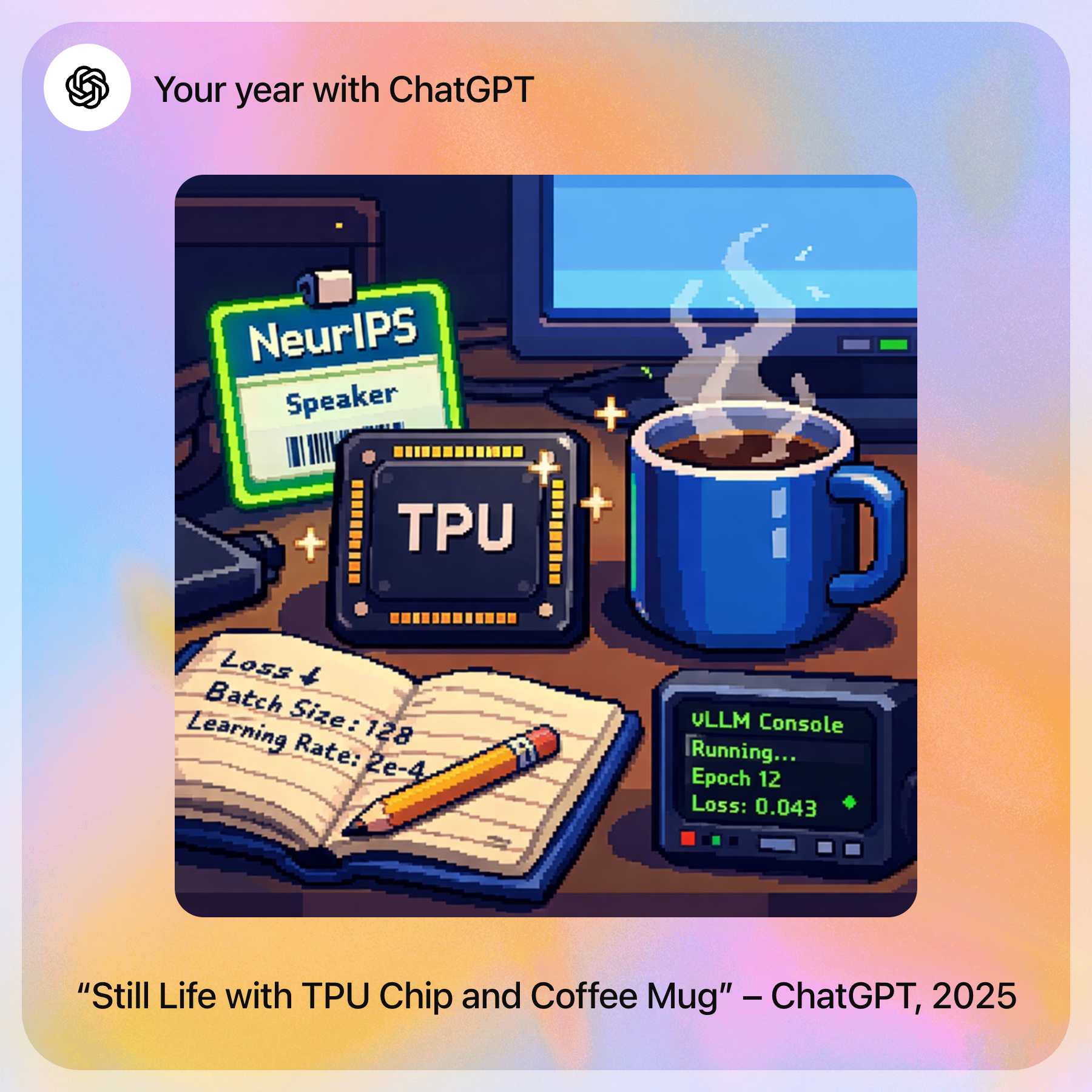
my year with ChatGPT:
("Hallucination": not GPU, but TPU?)
My Favorite AI Breakthrough This Year: DeepSeek
Foundation Model: Open vs Closed
2025 has been a year of shifts in the foundation model landscape. While we've seen more powerful models from Google DeepMind, Anthropic and OpenAI, the shift between open source and closed source continues to evolve. Companies like Meta and xAI switched their previously open-source mode to closed source. OpenAI shipped gpt-oss (their 1st open-source model family post GPT-3) in August 2025.
Despite these industry shifts, my favorite AI breakthrough this year remains DeepSeek. DeepSeek proved that open source is the way. Their unwavering commitment to openness, even as giants like Meta retreated, has inspired a new generation of open-source models including Alibaba Qwen, Kimi, Xiaomi MiMo, MiniMax and AI2's OLMo. Open source enables innovation, research, and democratization of AI technology.
- SpaceXAI's Grok 4.6 — one point off Fable 5 at 61, for $1.35 per 1M: ~82% cheaper (closed weights)
- DeepSeek's DeepSeek-V4-Pro-0813 — GA build of the 1.6T/49B MoE, 1M context, for $0.18 per 1M; DeepSeek's own agent evals put it level with Fable 5 on Terminal Bench 2.1 (87.9 vs 88.0) and Cybergym (83.3 vs 83.1), behind on DeepSWE (62.7 vs 70.0) — open weights
- Matt Garman, AWS CEO, posted that Amazon has signed the Open Weights and American AI Leadership letter — "Open and closed models are complementary."
- Dario Amodei, Anthropic CEO, posted Our Position on Open-Weights Models.
- Moonshot AI released the model weights and technical report of Kimi K3.
Evaluation, Alignment, Interpretability, Trust & Safety
Transitioning a probability-based LLM solution into a stable, consistency, production-ready product is not trivial. Last-mile delivery: from innovations to production readiness is important. Achieving production readiness requires extensive work, including rigorous benchmarking, thorough model evaluation, and, most importantly, establishing trust and safety. Some organizations have recognized these challenges and are actively building solutions to close the gap.—examples include Arklex.ai and Virtue AI.
Besides, "The Urgency of Interpretability" is clear, opening the black box is necessary.
Academia vs Industry Fusion
First, congratulations to Professors Andrew Barto of UMass Amherst—my graduate alma mater—and his former graduate student Richard Sutton on receiving the 2024 Turing Award this spring for their pioneering work in reinforcement learning.
NeurIPS 2025 in San Diego was a crowded and hugely successful event, showcasing the vibrant intersection of academic research and industrial innovation. The conference highlighted both the opportunities and challenges facing the AI research community. The unexpected incident involving OpenReview has drawn increased attention to fairness, impartiality, transparency, high quality, and privacy protection in academic sharing, prompting concrete actions across the research community, including the NeurIPS donation and the AI Research Leaders: Join Us in Supporting OpenReview initiative.
The ongoing discussion about research vs engineering has intensified this year. We're seeing fascinating position changes between veterans and young researchers, reflecting the evolving landscape of AI careers. 2025 marks a watershed moment as more 95s young researchers are becoming executives at major companies and startups, commanding compensation comparable to NBA stars in Bay Area tech. Notable examples include Shengjia Zhao (Chief Scientist at Meta Superintelligence Labs), Shunyu Yao (姚顺雨) at Tencent, and Fuli Luo (罗福莉) at Xiaomi. These leaders share a common profile: former researchers at OpenAI or top labs like DeepSeek, PhD from Stanford or UC Berkeley, and undergraduate degrees from Tsinghua or Peking University. For startup, we also have new research-type companies like Thinking Machines Lab (founded by former OpenAI CTO, Soumith Chintala, PyTorch co-creator, joined last month) and for corporate, Amazon recently appointing Pieter Abbeel (UC Berkeley professor, co-founder of Covariant) to lead their frontier model research team.
We're witnessing a destructive restructuring of the AI talent landscape. In this new era, everyone needs to find their position. The traditional career paths are being rewritten, and adaptability has become the most valuable skill.
Neo LabsNew · 2026
If 2025 was the year young researchers became executives, 2026 is the year the veterans left to found their own labs. The academia–industry fusion has entered a new phase: instead of joining existing giants, the most senior scientists are spinning up "neo labs" — small, research-first, thesis-driven companies, each betting on a different path beyond today's LLMs.
Sequoia Capital's Sonya Huang made the same call from the application side. In How Companies Are Building Their Own Intelligence, her opening remarks for Sequoia's "Own Your Intelligence" session, she argued that the endpoint for AI application companies is that every one of them becomes a Neo Lab.
Post-Training RLNew · 2026
Barto and Sutton's Turing Award proved prescient. In 2026, reinforcement learning is no longer just the final alignment step — post-training RL has become the main engine of capability gains. Reinforcement Learning with Verifiable Rewards (RLVR) and GRPO-style recipes, popularized by DeepSeek-R1, are now the standard post-training paradigm across frontier and open-weights labs alike.
The frontier has shifted from static reward datasets to environments: agentic RL trains models inside sandboxes with tools, code execution, and multi-step tasks, where feedback comes from the environment rather than a human label. Environments are becoming the new data — and building good ones is becoming its own discipline (see NVIDIA's agentic RL techniques write-up and the growing systems literature on scaling RL post-training).
The product argument runs alongside the technical one: at that same Sequoia Capital "Own Your Intelligence" session, Fireworks AI CEO Lin Qiao made the case that post-training is how you keep your taste (August 2026).
LLM Native: Open Source Ecosystem in Place
The shift toward GPU-CPU Native infrastructure has accelerated dramatically. Key projects driving this revolution include vLLM, SGLang, llm-d, Nvidia's Dynamo, and LMCache. Looking back at GTC 25, there was no "public" concept of disaggregated inference at all. Just one year later, industry standards have emerged and are growing rapidly. There's also an interesting discussion on customizing popular open-source libraries—check out this article.
The Cloud Native Computing Foundation (CNCF) turned 10. The Linux Foundation and open-source AI community have remained incredibly active in 2025, driving both agentic AI and foundation model ecosystems forward.
Agentic AI: Moving Fast
The industry consensus is clear: 2025 is the year of the agent. We've seen an explosion of agentic AI frameworks, tools, and applications that are fundamentally changing how we think about AI systems.
From autonomous coding assistants to multi-agent collaboration frameworks, agentic AI has moved from research novelty to production reality. Agent sandbox use cases have also brought Firecracker to the stage. The formation of the Agentic AI Foundation (AAIF) by the Linux Foundation signals that this trend is here to stay.
Expanded Cross-Company Partnerships
Before 2025, top AI labs were tied to one or two companies—OpenAI with Microsoft, Anthropic with Google and Amazon. This year, cross-company partnerships are expanding: OpenAI now works with Microsoft, Oracle, and AWS, while Claude Code is available on OpenRouter. Top AI labs also worked together, in August, OpenAI and Anthropic jointly conducted a pilot Alignment Evaluation Exercise and published research results.
More and More Data Center
Google’s TPU is back in the spotlight, even though it has been around for a long time. Meanwhile, the newly released Trainium 3 and Project Rainier, powered by Trainium 2, have been activated for Anthropic’s Claude model training and inference workloads. And multi-year, billion-dollar agreement between AWS and OpenAI. GPU versus ASIC chips. Undoubtedly, more and more purpose-built physical data centers are being constructed from the ground up, and energy become important.
Faster and Faster Performance Optimization
The token economy is becoming increasingly evident. More OPTS, shorter TTFT, and longer context lengths, the ranking race in Artificial Analysis continues. Performance and quality (a.k.a. cost efficiency) are becoming critically important at every layer—from applications and agent providers to API and model providers. Companies like Fireworks AI and Together AI did a good job in this domain. AI technologies are innovating fast — inference optimization techniques like speculative decoding are a prime example. Beginning with draft-model speculative decoding (Chen et al., 2023), later the EAGLE (Extrapolation Algorithm for Greater Language‑model Efficiency) series has pushed this approach further: EAGLE-1 (ICML 2024), EAGLE‑2 (EMNLP 2024), EAGLE‑3 (2025), and most recently, SuffixDecoding (NeurIPS 2025 spotlight poster).
And all of these new academic innovations are supported by the open-source community from Day 0 for industry adoption. Open-source speed is incredibly fast in today’s AI community.
Besides, low-level innovations like kernel tuning continue unabated—for example, Perplexity’s October open sourced kernel on GitHub and paper and companies like Cerebras AI design AI-native processors and infrastructure, result in high performance through tight hardware–software combination. Behind high performance is a high-quality dataset.
Pitch Over Performance
Personal experience. Nano Banana did not fully meet expectations, requiring intensive prompting and still leaving room for fine-tuning.
Productivity
Coding: Kiro CLI, Cursor and Claude Code. Doc: ChatGPT. Knowledge: Perplexity.
LLM 3 Years
From conversational AI in 2019 to Bedrock in 2023—I become a three-year "veteran" in the LLM domain. OpenAI turns 10 this month: https://openai.com/index/ten-years/. This space is growing at an unimaginable pace, hype and the unknown intertwined. When an industrial revolution is underway, people can only move forward step by step. See @karpathy and @rakyll threads. Recommended interviews: Geoff Hinton & Jeff Dean, Ilya Sutskever, Linus Torvalds, Andrew Ng and Google's blog.
What's Next
No direct answer, but open source will continue to be the way.
- The Anthropic Institute, led by Anthropic co-founder Jack Clark, published "What will our economic future look like?" — an interactive model spanning three AI growth scenarios through 2030 (AnthropicAI, Jack Clark).
- Jacob Coxon, ex-Anthropic/OpenAI pretraining researcher, resigned, warning AI could kill everyone by 2030.
- OpenAI voiced support for Pacing the Frontier — a statement from 1,178 employees of frontier AI companies (signatories include Jakub Pachocki, Dario Amodei, Benjamin Mann, John Schulman, Shengjia Zhao, Dawn Song) requesting that the U.S. government support an international effort to develop the technical and governance tools to deliberately pace automated AI development.
- Mark Zuckerberg, Meta CEO, published the WSJ op-ed "The AI Future Is for Everyone" — superintelligence should broadly empower individuals rather than be centrally controlled by a few institutions.
继 @karpathy 的 2025 LLM 年度回顾之后,这里是我对 2025 年 LLM 领域的一些观察。
我与 ChatGPT 的这一年:
("幻觉":不是 GPU,而是 TPU?)
我今年最喜欢的 AI 突破:DeepSeek
基础模型:开权 vs 闭源
2025 年是基础模型格局发生转变的一年。虽然我们看到 Google DeepMind、Anthropic 和 OpenAI 推出了更强大的模型,开源与闭源之间的转换仍在持续演变。Meta 和 xAI 等公司把此前的开源模式转向了闭源。OpenAI 在 2025 年 8 月发布了 gpt-oss(继 GPT-3 之后其首个开源模型系列)。
尽管行业出现了这些转变,我今年最喜欢的 AI 突破仍然是 DeepSeek。DeepSeek 证明了开源可行。他们对开放性坚定不移的承诺——即便像 Meta 这样的巨头都在退缩——启发了新一代开源模型,包括阿里巴巴 Qwen、Kimi、小米 MiMo、MiniMax 以及 AI2 的 OLMo。开源推动了创新、研究,以及 AI 技术的民主化。
- SpaceXAI 发布 Grok 4.6——61 分,仅落后 Fable 5 一分,每 100 万 token 1.35 美元:便宜约 82%(闭源权重)
- DeepSeek 发布 DeepSeek-V4-Pro-0813——1.6 万亿参数 MoE(490 亿激活)的正式版、100 万 token 上下文,每 100 万 token 0.18 美元;DeepSeek 自己的智能体评测显示,它在 Terminal Bench 2.1(87.9 对 88.0)与 Cybergym(83.3 对 83.1)上与 Fable 5 持平,在 DeepSWE(62.7 对 70.0)上落后——开源权重
- AWS CEO Matt Garman 发文宣布亚马逊已签署《开放权重与美国 AI 领导力》公开信——"开放模型与闭源模型是互补的。"
- Anthropic CEO Dario Amodei 发表《我们对开放权重模型的立场》。
- 月之暗面发布了 Kimi K3 的模型权重与技术报告。
评测、对齐、可解释性、信任与安全
将一个基于概率的 LLM 方案,转变为稳定、一致、可用于生产的产品,绝非易事。最后一公里的交付——从创新到生产就绪——至关重要。要实现生产就绪,需要大量工作,包括严格的基准评测、全面的模型评估,以及最重要的一点:建立信任与安全。一些机构已经意识到这些挑战,并正在积极构建解决方案来弥补差距——例如 Arklex.ai 与 Virtue AI。
此外,"可解释性的紧迫性"已经十分明确,打开黑箱是必要之举。
学术界与产业界的融合
首先,祝贺马萨诸塞大学阿默斯特分校(我的研究生母校)教授 Andrew Barto 及其昔日的博士生 Richard Sutton,凭借他们在强化学习领域的开创性工作,于今年春天荣获2024 年图灵奖。
在圣迭戈举行的NeurIPS 2025是一场人潮涌动、极为成功的盛会,展现了学术研究与产业创新蓬勃交汇的景象。这次会议也凸显了 AI 研究界所面临的机遇与挑战。围绕 OpenReview 的意外事件,让业界更加关注学术分享中的公平性、公正性、透明度、高质量与隐私保护,并促使研究社区采取了具体行动,包括 NeurIPS 的捐款以及AI Research Leaders: Join Us in Supporting OpenReview倡议。
关于研究与工程的持续讨论在今年愈发激烈。我们看到资深人士与年轻研究者之间的地位正在发生有趣的变化,这也反映出 AI 职业格局的演变。2025 年标志着一个分水岭:越来越多 95 后年轻研究者成为大公司和创业公司的高管,薪酬待遇堪比湾区科技圈的 NBA 球星。典型例子包括在 Meta Superintelligence Labs 担任首席科学家的 Shengjia Zhao(赵晟佳)、在腾讯任职的 Shunyu Yao(姚顺雨),以及在小米任职的 Fuli Luo(罗福莉)。这些领军人物有着相似的履历:曾在 OpenAI 或 DeepSeek 等顶尖实验室担任研究员,拥有斯坦福或加州大学伯克利分校的博士学位,本科则毕业于清华或北大。在创业公司方面,我们也看到了 Thinking Machines Lab 这样的新型研究型公司(由前 OpenAI CTO、PyTorch 联合创始人 Soumith Chintala 创立,他上个月刚加入);在大企业方面,Amazon 最近任命 Pieter Abbeel(加州大学伯克利分校教授、Covariant 联合创始人)领导其前沿模型研究团队。
我们正在见证 AI 人才格局的一场颠覆式重构。在这个新时代,每个人都需要重新找到自己的位置。传统的职业路径正在被重写,适应能力已成为最宝贵的技能。
新型实验室新 · 2026
如果说 2025 年是年轻研究者走上高管岗位的一年,那么 2026 年就是行业元老纷纷出走、创办自己实验室的一年。学术界与产业界的融合进入了新阶段:最资深的科学家不再加入现有巨头,而是创建"新型实验室"(Neo Labs)——小而精、研究至上、由核心命题驱动的公司,各自押注一条超越今日 LLM 的路径。
红杉资本的 Sonya Huang 从应用层这一侧,呼应了同样的判断。在「Own Your Intelligence」(掌握自己的智识)系列专题的开场演讲《How Companies Are Building Their Own Intelligence》中,她提出:AI 应用公司的终点,是每一家都变成 Neo-Lab。
后训练强化学习新 · 2026
Barto 与 Sutton 的图灵奖颇有先见之明。到了 2026 年,强化学习不再只是最后的对齐环节——后训练强化学习(Post-Training RL)已成为模型能力提升的主引擎。由 DeepSeek-R1 带火的可验证奖励强化学习(RLVR)与 GRPO 式训练配方,如今已是前沿实验室与开源权重实验室共同采用的标准后训练范式。
前沿正从静态奖励数据集转向环境(environments):智能体强化学习让模型在带工具、代码执行与多步任务的沙箱中训练,反馈来自环境而非人工标注。环境正在成为新的数据——而构建高质量环境本身也正在成为一门学问(可参见 NVIDIA 的智能体强化学习技术一文,以及日益增多的RL 后训练规模化系统研究)。
产品层面的论证与技术层面同向:在同一场红杉资本「Own Your Intelligence」专题活动上,Fireworks AI CEO Lin Qiao 认为,后训练才是你守住品味的方式(2026 年 8 月)。
LLM Native:开源生态已然成形
向 GPU-CPU 原生基础设施的转变正在急剧加速。推动这场变革的关键项目包括 vLLM、SGLang、llm-d、Nvidia 的 Dynamo,以及 LMCache。回顾 GTC 25,当时业界对"分离式推理"还完全没有任何"公开"的概念。仅仅一年之后,行业标准已经涌现并迅速壮大。关于如何定制热门开源库,也出现了一场有趣的讨论——可参见这篇文章。
云原生计算基金会(CNCF)迎来十周年。Linux 基金会与开源 AI 社区在 2025 年依旧异常活跃,持续推动智能体 AI 与基础模型生态的发展。
智能体 AI:高速前进
行业共识很明确:2025 年是智能体之年。我们见证了智能体 AI 框架、工具与应用的大爆发,从根本上改变了我们对 AI 系统的理解方式。
从自动化编码助手到多智能体协作框架,智能体 AI 已从研究新奇事物走向生产落地的现实。智能体沙箱场景也让 Firecracker 走上舞台。Linux 基金会成立 Agentic AI Foundation(AAIF),标志着这一趋势将长期延续。
跨公司合作不断扩展
2025 年之前,顶尖 AI 实验室往往只与一两家公司绑定:OpenAI 与 Microsoft,Anthropic 与谷歌、Amazon。今年,跨公司合作正在扩展:OpenAI 如今同时与 Microsoft、Oracle 和 AWS 合作,Claude Code 也已在 OpenRouter 上线。顶尖 AI 实验室之间也开始协作,8 月,OpenAI 与 Anthropic 联合开展了一项试点对齐评估演练(Alignment Evaluation Exercise),并公布了研究结果。
越来越多的数据中心
谷歌的 TPU 再度回到聚光灯下,尽管它其实已经存在了很长时间。同时,新发布的 Trainium 3 以及由 Trainium 2 驱动的 Project Rainier,已投入 Anthropic 的 Claude 模型训练与推理工作负载。此外,AWS 与 OpenAI 之间还达成了一项数年、数十亿美元规模的协议。GPU 与 ASIC 芯片之争仍在继续。毫无疑问,越来越多专用的物理数据中心正在从零开始兴建,而能源问题也变得日益重要。
越来越快的性能优化
Token 经济日益明显。更高的 OPTS、更短的 TTFT、更长的上下文长度——Artificial Analysis 上的排名竞赛仍在持续。性能与质量(亦即成本效率)正变得在每一层都至关重要——从应用层、智能体提供方,到 API 与模型提供方。Fireworks AI 和 Together AI 等公司在这一领域做得不错。AI 技术的创新速度极快——推理优化技术,比如投机解码,就是一个典型例子。从最早的草稿模型投机解码(Chen 等人,2023)开始,后续的 EAGLE(Extrapolation Algorithm for Greater Language‑model Efficiency)系列将这一思路进一步推进:EAGLE-1(ICML 2024)、EAGLE‑2(EMNLP 2024)、EAGLE‑3(2025),以及最近的 SuffixDecoding(NeurIPS 2025 焦点海报)。
所有这些新的学术创新,从第 0 天起就获得了开源社区的支持,从而快速走向产业应用。在今天的 AI 社区里,开源的速度快得令人难以置信。
此外,像内核调优这样的底层创新也未曾停歇——例如,Perplexity 10 月在 GitHub 上开源的内核及其论文,以及 Cerebras AI 等公司设计的 AI 原生处理器与基础设施,都通过软硬件的紧密结合实现了高性能。而高性能的背后,是高质量的数据集。
叙事胜于性能
个人体验:Nano Banana 并未完全达到预期,需要投入大量的提示词调试,仍有不少精调的空间。
生产力工具
编码:Kiro CLI、Cursor 和 Claude Code。文档:ChatGPT。知识:Perplexity。
与 LLM 相伴的三年
从 2019 年接触对话式 AI,到 2023 年投身 Bedrock,我已成为 LLM 领域一名"三年老兵"。OpenAI 本月迎来十周年:https://openai.com/index/ten-years/。这个领域正以难以想象的速度增长,炒作与未知交织在一起。当一场产业革命正在发生时,人们只能一步一步向前走。可参见 @karpathy 与 @rakyll 的讨论帖。推荐访谈:Geoff Hinton 与 Jeff Dean、Ilya Sutskever、Linus Torvalds、Andrew Ng,以及谷歌的博客。
接下来会发生什么
没有直接的答案,但开源仍将继续是正道。
- 由 Anthropic 联合创始人 Jack Clark 领导的 Anthropic Institute 发布《我们的经济未来会是什么样?》——一个涵盖三种 AI 增长情景、预测至 2030 年的交互模型(AnthropicAI、Jack Clark)。
- 前 Anthropic/OpenAI 预训练研究员 Jacob Coxon 宣布辞职,警告 AI 可能在 2030 年前毁灭人类。
- OpenAI 发声支持 Pacing the Frontier——一份由 1,178 名前沿 AI 公司员工签署的声明(签署者包括 Jakub Pachocki、Dario Amodei、Benjamin Mann、John Schulman、Shengjia Zhao、Dawn Song),呼吁美国政府支持一项国际合作,开发有意调控(pace)自动化 AI 研发速度所需的技术与治理工具。
- Meta CEO Mark Zuckerberg 在《华尔街日报》发表评论文章《AI 的未来属于每一个人》——超级智能应当广泛赋能个人,而不是被少数机构集中掌控。