LLM Year in Review
Following @karpathy's 2025 LLM Year in Review, here are my observations on the LLM landscape in 2025.
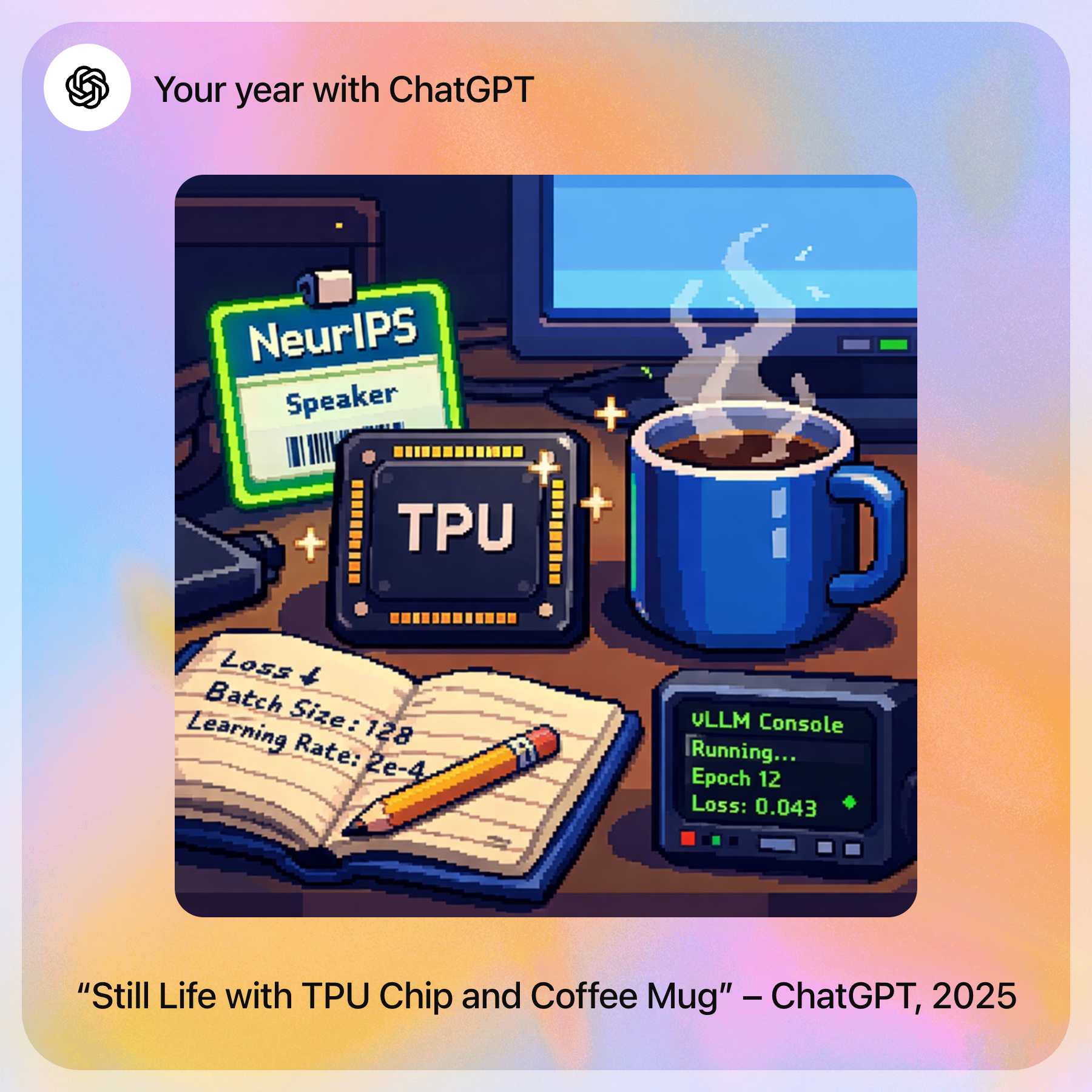
my year with ChatGPT:
("Hallucination": not GPU, but TPU?)
My Favorite AI Breakthrough This Year: DeepSeek
Foundation Model: Open Source vs Closed Source
2025 has been a year of shifts in the foundation model landscape. While we've seen more powerful models from Google DeepMind, Anthropic and OpenAI, the shift between open source and closed source continues to evolve. Companies like Meta and xAI switched their previously open-source mode to closed source. OpenAI shipped gpt-oss (their 1st open-source model family post GPT-3) in August 2025.
Despite these industry shifts, my favorite AI breakthrough this year remains DeepSeek. DeepSeek proved that open source is the way. Their unwavering commitment to openness, even as giants like Meta retreated, has inspired a new generation of open-source models including Alibaba Qwen, Kimi, Xiaomi MiMo, MiniMax and AI2's OLMo. Open source enables innovation, research, and democratization of AI technology.
Academia vs Industry Fusion
First, congratulations to Professors Andrew Barto of UMass Amherst—my graduate alma mater—and his former graduate student Richard Sutton on receiving the 2024 Turing Award this spring for their pioneering work in reinforcement learning.
NeurIPS 2025 in San Diego was a crowded and hugely successful event, showcasing the vibrant intersection of academic research and industrial innovation. The conference highlighted both the opportunities and challenges facing the AI research community. The unexpected incident involving OpenReview has drawn increased attention to fairness, impartiality, transparency, high quality, and privacy protection in academic sharing, prompting concrete actions across the research community, including the NeurIPS donation and the AI Research Leaders: Join Us in Supporting OpenReview initiative.
The ongoing discussion about research vs engineering has intensified this year. We're seeing fascinating position changes between veterans and young researchers, reflecting the evolving landscape of AI careers. 2025 marks a watershed moment as more 95s young researchers are becoming executives at major companies and startups, commanding compensation comparable to NBA stars in Bay Area tech. Notable examples include Shengjia Zhao (Chief Scientist at Meta Superintelligence Labs), Shunyu Yao (姚顺雨) at Tencent, and Fuli Luo (罗福莉) at Xiaomi. These leaders share a common profile: former researchers at OpenAI or top labs like DeepSeek, PhD from Stanford or UC Berkeley, and undergraduate degrees from Tsinghua or Peking University. For startup, we also have new research-type companies like Thinking Machines Lab (founded by former OpenAI CTO, Soumith Chintala, PyTorch co-creator, joined last month) and for corporate, Amazon recently appointing Pieter Abbeel (UC Berkeley professor, co-founder of Covariant) to lead their frontier model research team.
We're witnessing a destructive restructuring of the AI talent landscape. In this new era, everyone needs to find their position. The traditional career paths are being rewritten, and adaptability has become the most valuable skill.
LLM Native: Open Source Ecosystem in Place
The shift toward GPU-CPU Native infrastructure has accelerated dramatically. Key projects driving this revolution include vLLM, SGLang, llm-d, Nvidia's Dynamo, and LMCache. Looking back at GTC 25, there was no "public" concept of disaggregated inference at all. Just one year later, industry standards have emerged and are growing rapidly. There's also an interesting discussion on customizing popular open-source libraries—check out this article.
The Cloud Native Computing Foundation (CNCF) turned 10. The Linux Foundation and open-source AI community have remained incredibly active in 2025, driving both agentic AI and foundation model ecosystems forward.
Agentic AI: Moving Fast
The industry consensus is clear: 2025 is the year of the agent. We've seen an explosion of agentic AI frameworks, tools, and applications that are fundamentally changing how we think about AI systems.
From autonomous coding assistants to multi-agent collaboration frameworks, agentic AI has moved from research novelty to production reality. Agent sandbox use cases have also brought Firecracker to the stage. The formation of the Agentic AI Foundation (AAIF) by the Linux Foundation signals that this trend is here to stay.
Expanded Cross-Company Partnerships
Before 2025, top AI labs were tied to one or two companies—OpenAI with Microsoft, Anthropic with Google and Amazon. This year, cross-company partnerships are expanding: OpenAI now works with Microsoft, Oracle, and AWS, while Claude Code is available on OpenRouter. Top AI labs also worked together, in August, OpenAI and Anthropic jointly conducted a pilot Alignment Evaluation Exercise and published research results.
More and More Data Center
Google’s TPU is back in the spotlight, even though it has been around for a long time. Meanwhile, the newly released Trainium 3 and Project Rainier, powered by Trainium 2, have been activated for Anthropic’s Claude model training and inference workloads. And multi-year, billion-dollar agreement between AWS and OpenAI. GPU versus ASIC chips. Undoubtedly, more and more purpose-built physical data centers are being constructed from the ground up, and energy become important.
Faster and Faster Performance
More OPTS, shorter TTFT, and longer context lengths, the ranking race in Artificial Analysis continues. Performance is becoming critically important at every layer—from applications and agent providers to API and model providers. Companies like Fireworks AI and Together AI did a good job in this domain. AI technologies are innovating fast — inference optimization techniques like speculative decoding are a prime example. Beginning with draft-model speculative decoding (Chen et al., 2023), later the EAGLE (Extrapolation Algorithm for Greater Language‑model Efficiency) series has pushed this approach further: EAGLE-1 (ICML 2024), EAGLE‑2 (EMNLP 2024), EAGLE‑3 (2025), and most recently, SuffixDecoding (NeurIPS 2025 spotlight poster).
And all of these new academic innovations are supported by the open-source community from Day 0 for industry adoption. Open-source speed is incredibly fast in today’s AI community. Besides, low-level innovations like kernel tuning continue unabated—for example, Perplexity’s October open sourced kernel on GitHub and paper and companies like Cerebras AI design AI-native processors and infrastructure, result in high performance through tight hardware–software combination. Behind high performance is a high-quality dataset.
Benchmark, Interpretability, Observability, Trust & Safety
Transitioning a probability-based LLM solution into a stable, consistency, production-ready product is not trivial. Last-mile delivery: from innovations to production readiness is important. Achieving production readiness requires extensive work, including rigorous benchmarking, thorough model evaluation, and, most importantly, establishing trust and safety. Some organizations have recognized these challenges and are actively building solutions to close the gap.—examples include Arklex.ai and Virtue AI.
Besides, "The Urgency of Interpretability" is clear, opening the black box is necessary.
Pitch Over Performance
Personal experience. Nano Banana did not fully meet expectations, requiring intensive prompting and still leaving room for fine-tuning.
Productivity
Coding: Kiro CLI, Cursor and Claude Code. Doc: ChatGPT. Knowledge: Perplexity.
LLM 3 Years
From conversational AI in 2019 to Bedrock in 2023—I become a three-year "veteran" in the LLM domain. OpenAI turns 10 this month: https://openai.com/index/ten-years/. This space is growing at an unimaginable pace, hype and the unknown intertwined. When an industrial revolution is underway, people can only move forward step by step. See @karpathy and @rakyll threads. Recommended interviews: Geoff Hinton & Jeff Dean, Ilya Sutskever, Linus Torvalds, Andrew Ng and Google's blog.
What's Next
No direct answer, but open source will continue to be the way.
